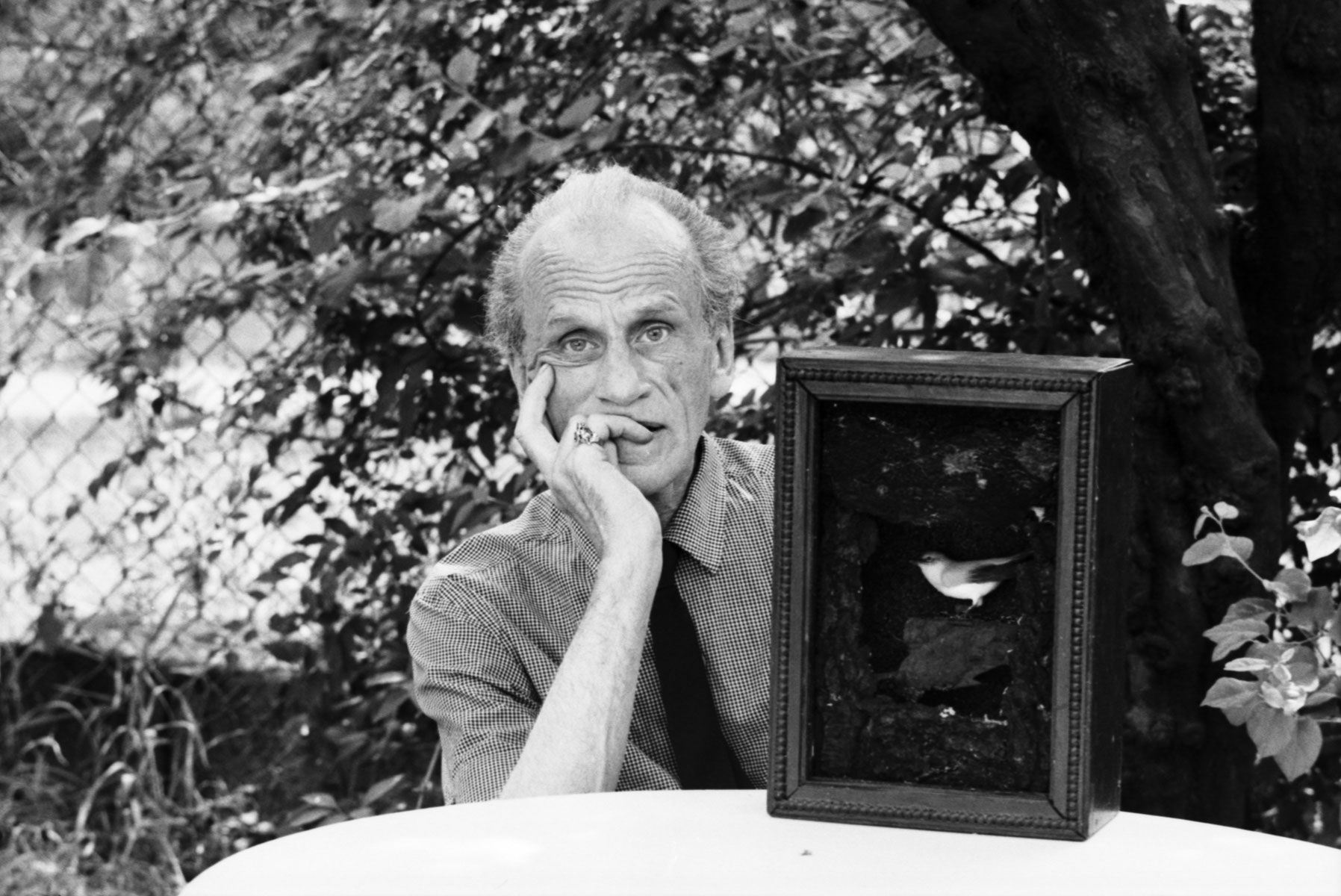
Joseph Cornell (1903 – 1972) was an American visual artist and filmmaker, one of the pioneers and most celebrated exponents of assemblage. Largely self-taught, he improvised a singular visual language built from cast-off artifacts, found photographs, and Victorian bric-a-brac, creating boxed assemblages whose poetic juxtapositions merge the formal restraint of Constructivism with the dreamlike associations of Surrealism. Living much of his life in relative isolation while caring for his mother and disabled brother, Cornell nonetheless remained deeply attuned to contemporary art circles, producing shadow boxes—often meant to be handled—that invite intimate, imaginative engagement. Among his most structurally rigorous works are the Dovecote boxes of the mid-1940s, whose spare grids, repeated compartments, and circular or rectangular openings approach pure abstraction while evoking architectural precedents such as Mondrian’s New York paintings and the white geometries of the International Style. In these works, repetition becomes both form and image: a taxonomic structure animated by subtle variations, symbolic associations, and references to aviaries, birdhouses, and even the portholes of ocean liners that linked Cornell to the European artistic traditions he so revered.
Presentation
Exhibitions In Our Galleries
All Exhibitions
Bibliography