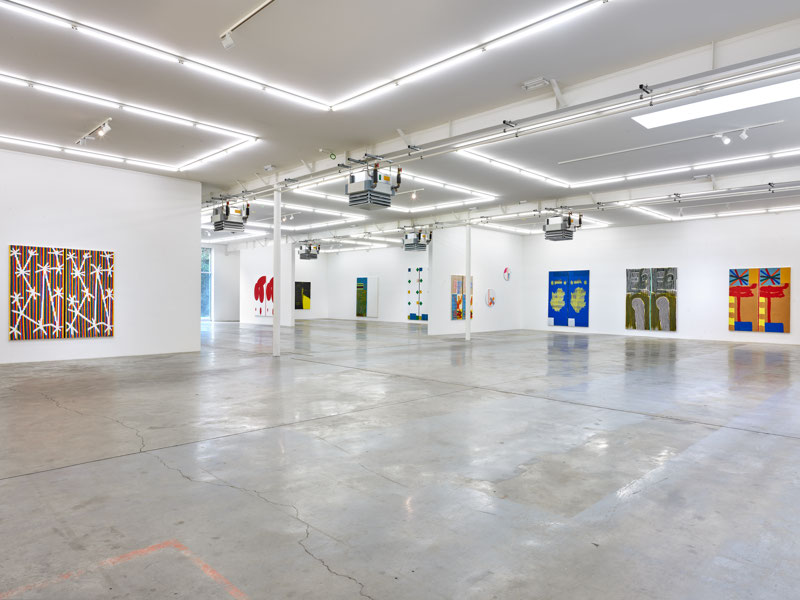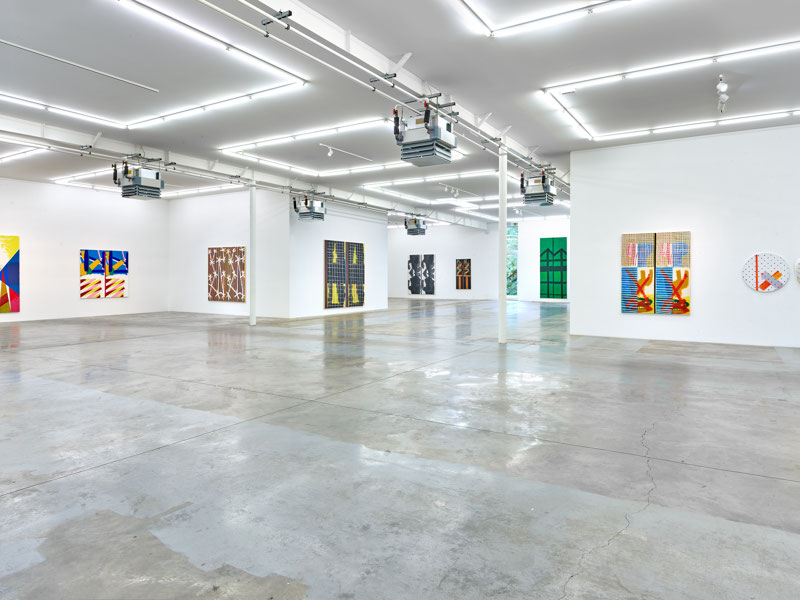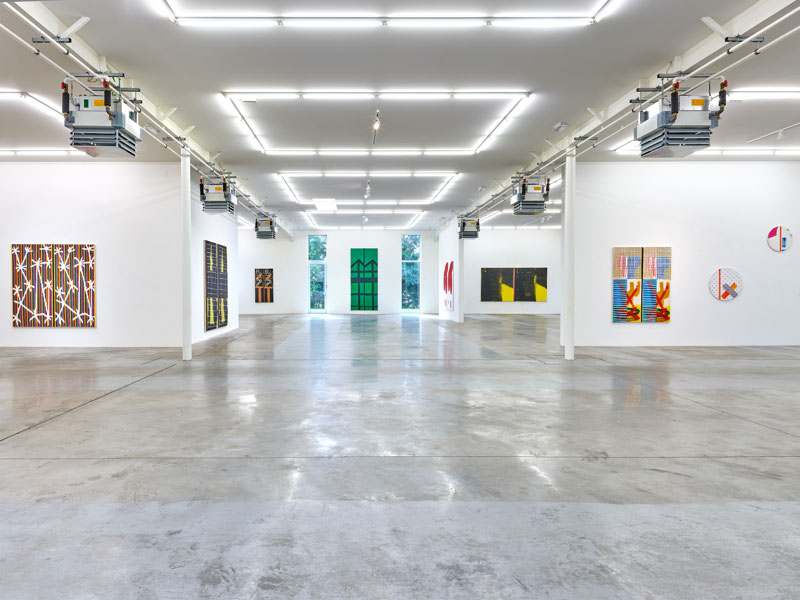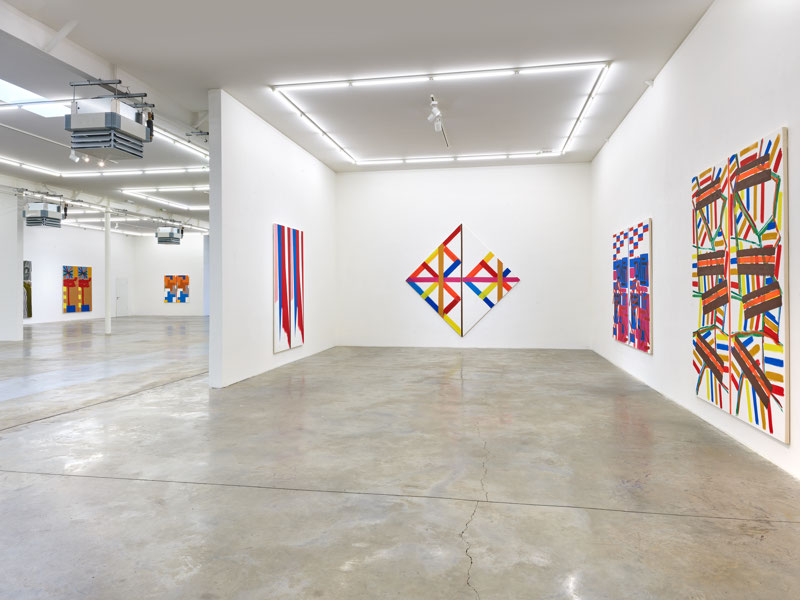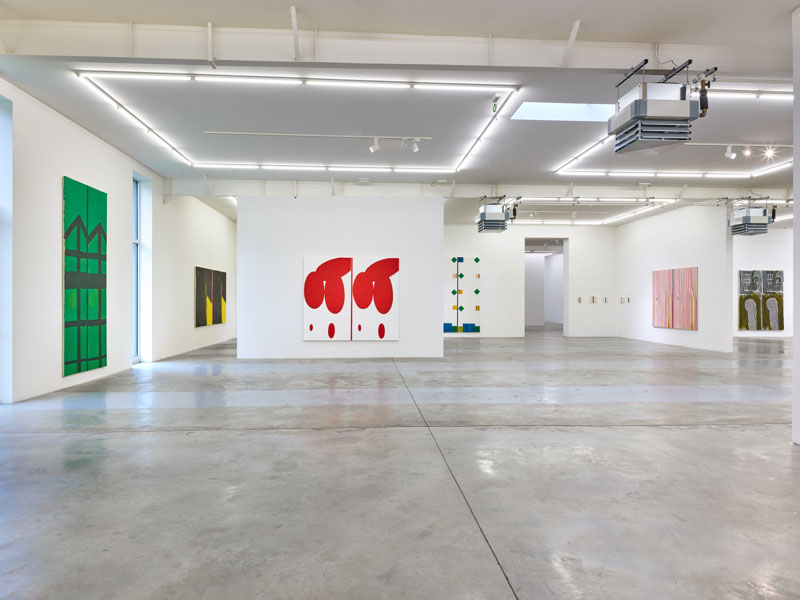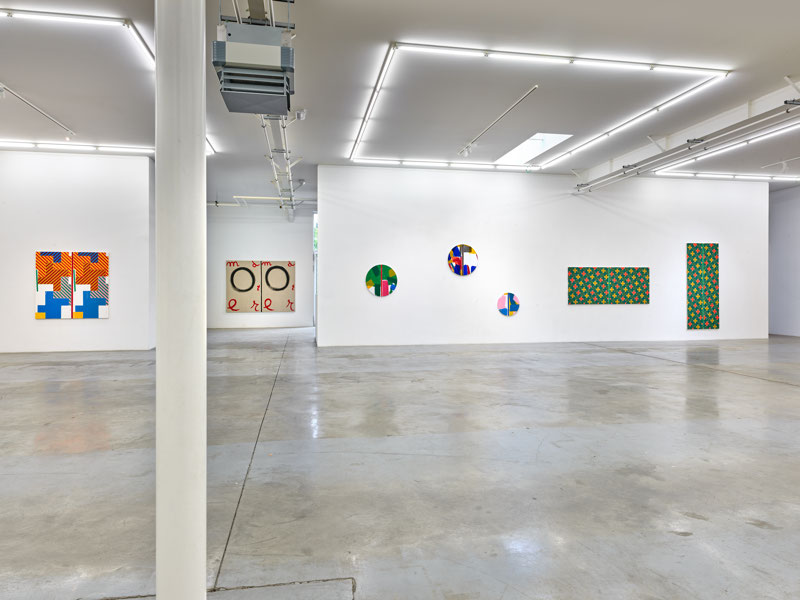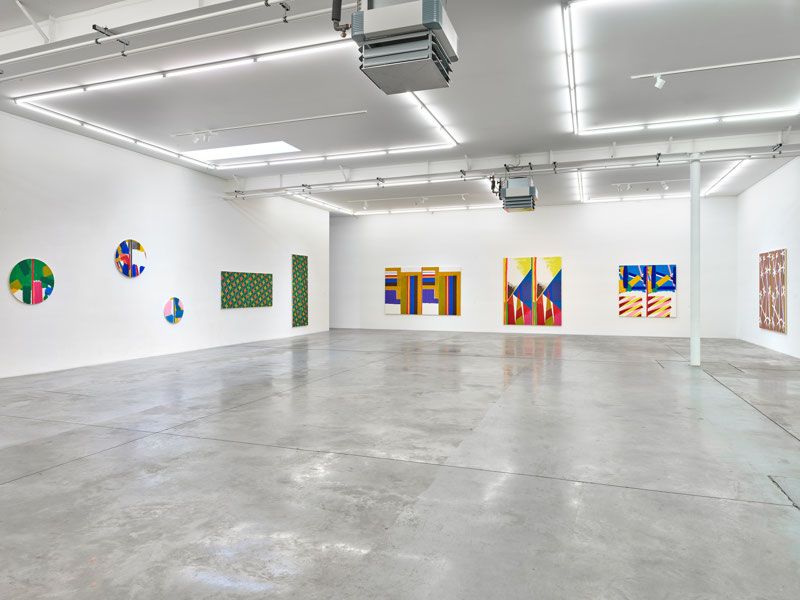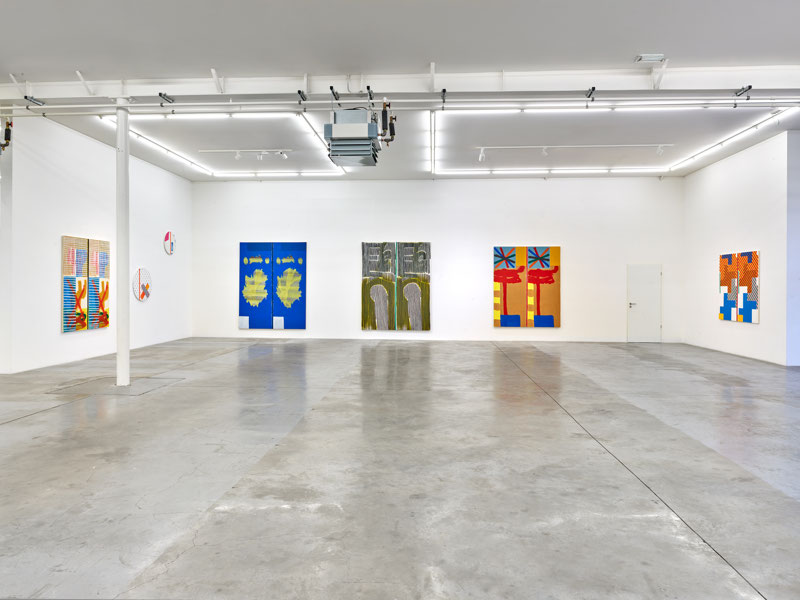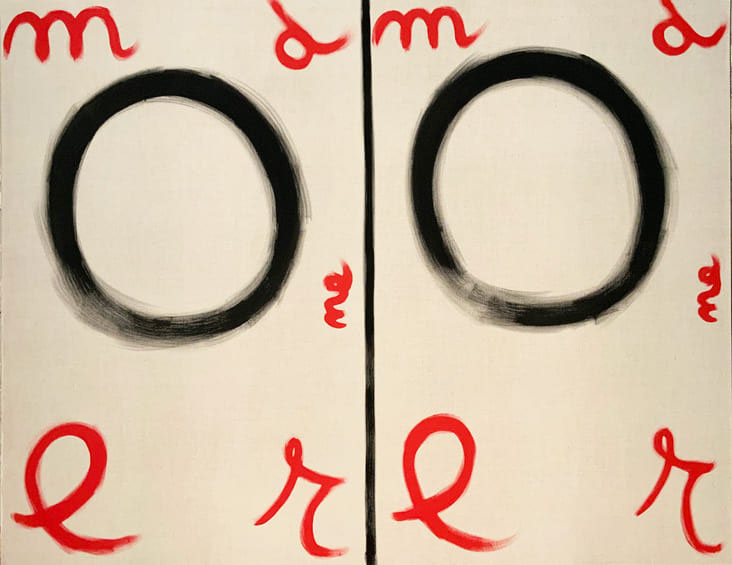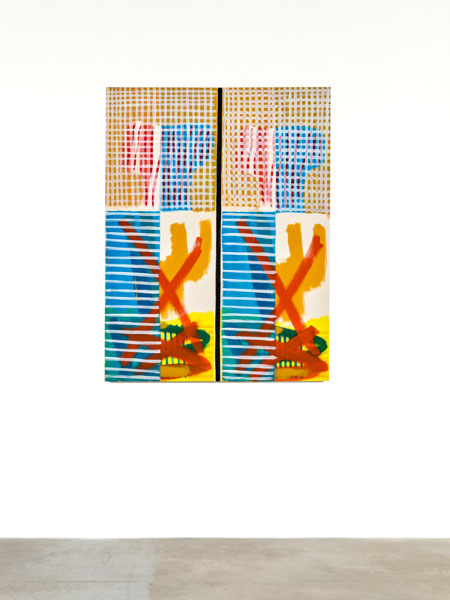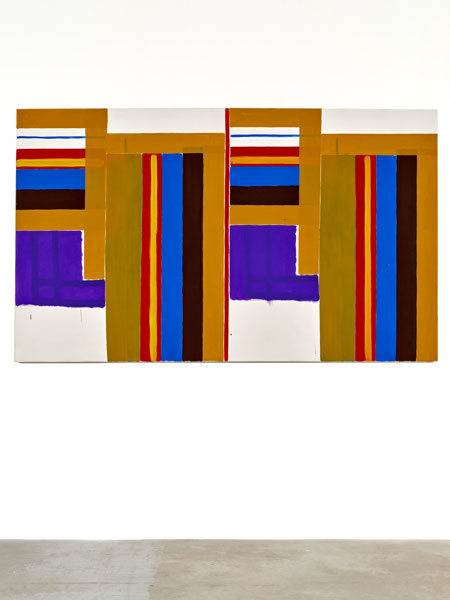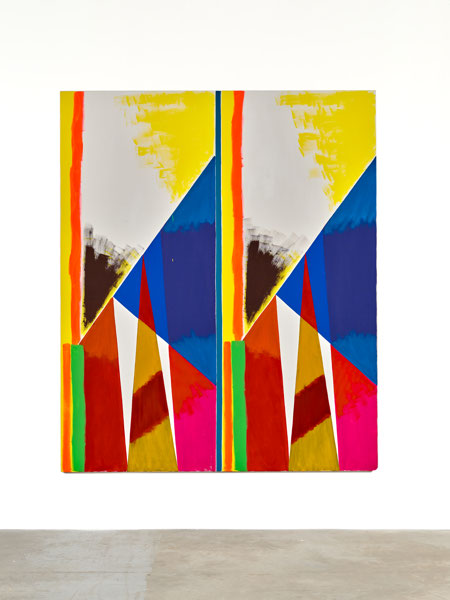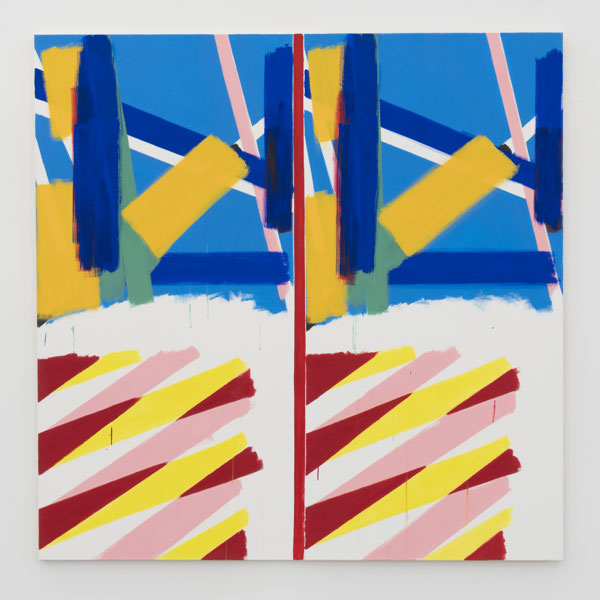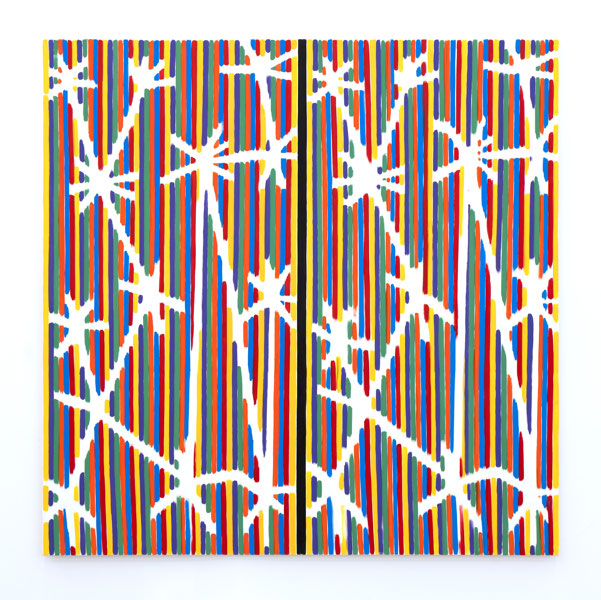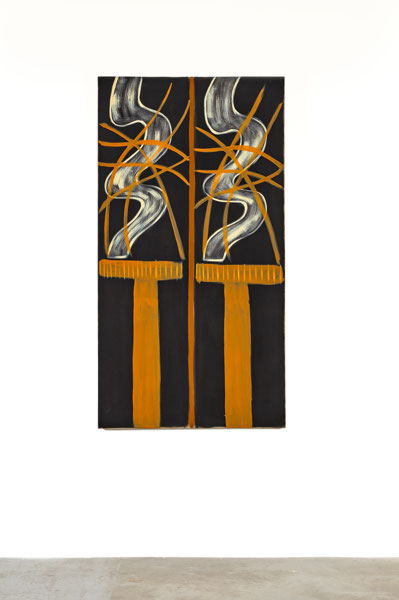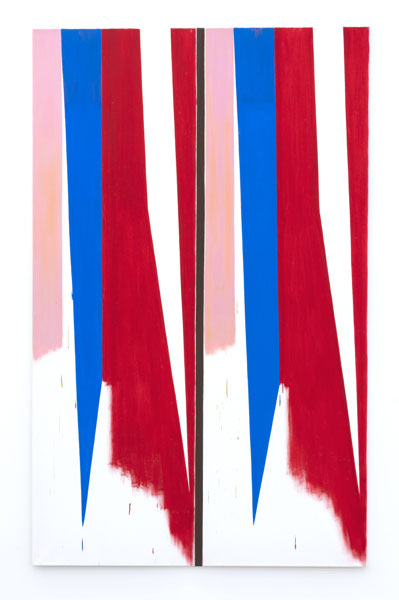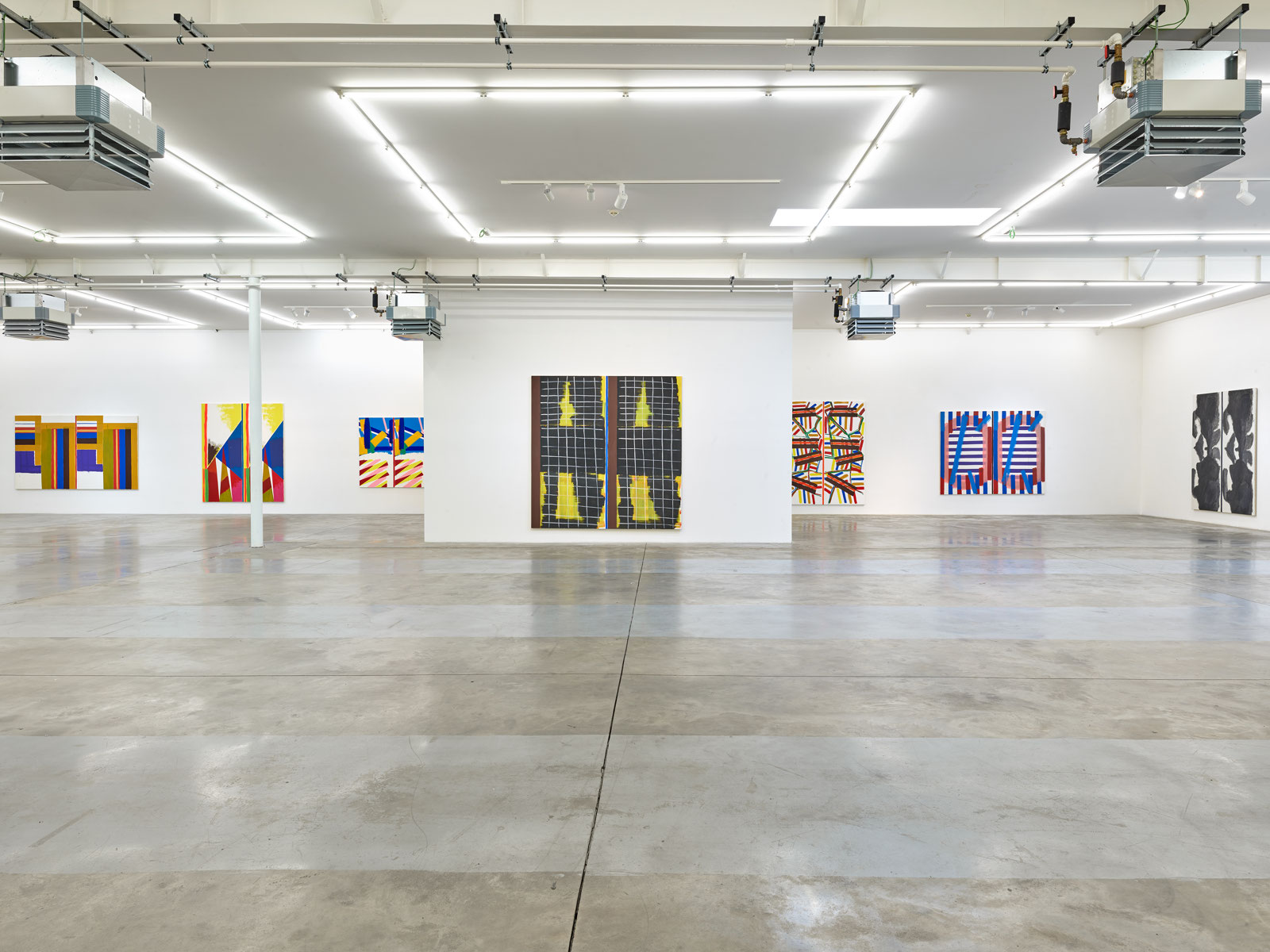
For over forty years, Bernard Piffaretti has developed a singular body of work, structured around a rigorous methodology: duplication. Each painting is divided in half by a central axis. On one side, the painter acts freely; on the other, he repeats — by hand, without tracing or mechanical aid — the initial gesture. This deliberate doubling is a systematic strategy which, by neutralizing the impulsive energy of the first moment, distances expressivity in order to better reveal the very nature of painting (acry. on c. 23, 2005).
Far from being a rigid system, this protocol generates an infinite variety of paintings — each autonomous, each incomparable. Piffaretti’s ever-expanding cosmogony nevertheless obeys an idea of organic and continuous unity, where each work relates to the others, like fragments of a single text in perpetual composition. Within this vast pictorial syntax, several "figures" emerge. The classics deploy the process with clarity and rigor (acry. on c.. 15, 2001), each half executed in the same momentum, repeating the still-warm layers of paint. The duplication is a visual echo, performed stroke by stroke, canceling all subjectivity from the first side.
This structural device — seemingly simple — allows the artist to establish what he calls a metapainting. A painting that exists in-between, beyond, after: meta in its fullest sense. The canvas doesn’t simply display an image; it stages painting as it unfolds, raising the foundational questions that run through the artist’s practice (acry. on c.. 95, 1993, What is Modern Art). In replicating his own gesture, Piffaretti avoids style effects or virtuosity. The canvas becomes a critical space, a mirror held up to art history — to its ruptures, myths, and disguised returns.
In a recent text, Piffaretti refers to PICK UPs, borrowed from Marcel Duchamp — moments of citation, reappropriation, reformulation. From Matisse to Pollock, from 16th-century BC Santorini ceramics to 20th-century avant-gardes, art is built on disguised reinventions, on second times. The artist does not advance in a straight line; he glances back over his shoulder.
Each painting becomes both a memory and an invention — an image that doubts its own origin as much as it resists its completion. Duplication introduces a fracture: what repeats is never quite the same, and what begins again never returns to its original point. In that tension, the painting finds autonomy — neither narrative, nor purely gestural, nor strictly conceptual — but rooted in a present of painting: a field still rich with affect, action, and critique.
Faced with this, the viewer is never passive. Their gaze is caught in a dynamic of back-and-forth, of verification and adjustment. To look at a painting by Bernard Piffaretti is to retrace, in thought, the painter’s own process. The Kine figures transport the viewer to the heart of the compositional act (acry. on c.. 237, 2016). These juxtapositions of canvases — evoking the kinorama — contain a single vertical line, like a panoramic trace of a painting’s inception. We stand before the primal situation, the scar of the first gesture. Embarked in the act of painting, we become co-creators, actors of the gaze, in the sense described by Georges Didi-Huberman when he wrote, “to see is to be delayed by what one sees.”
As emancipated spectators, we recompose, reinterpret, invent rather than passively receive meaning. With Piffaretti, the painting yields nothing — it proposes, provokes, and insists. It summons a thinking gaze, an attentive eye to what is replayed, displaced, lost, or rejected. The negative paintings are fragments of canvases that never existed, painted on tondos (acrylic. on c.. 234, 2006–2017). The central axis is not always centered, suggesting that these works function as a kind of focus. Hung with intentionally large empty spaces around them, they act as mental projection screens — spaces for the viewer’s imagination.
In the XXL exhibition, recent works are shown alongside earlier paintings, without concern for chronology. This deliberate temporal disruption foregrounds the “pictorial situation”: a state where painting does not signify, but shows — does not narrate, but provokes. The painting represents nothing beyond itself — it is surface, phenomenon, event (acry. on c.. 259, 2005).
The Unfinished figures (acry. on c.. 185, 1997) make the duplication process palpable. Whereas the classics replay pictorial situations from one half to the other, here, the second half has been left fallow for too long — the process has been forgotten. The elements can no longer be recalled; memory fails. Copying would be easy — but that is not the point. The artist leaves a white surface instead.
The Drawings After Painting also disrupt usual timelines. These graphic works are never preparatory — they come after the painting, re-emphasizing its visible surface by echoing its structure, chromatic logic, and gestural language (mixed media on paper, 233, 1991–2020).
In doing so, the artist situates painting as resting upon itself — exposing its grammar, mechanics, and temporal depth. He confronts painting with its own regime. The small paintings explore the full range of traditional formats: scraps of canvas are collaged onto round, rectangular, portrait, or landscape-shaped stretchers (acry. on c.. 235, 1995–2017). These are signs of the painting as object.
With Bernard Piffaretti, painting moves within a fertile in-between — between already-there and not-yet, between repetition and invention. In its apparent simplicity, the canvas reveals a tension between what returns and what escapes. Perhaps this is what it means today — to paint painting.