Claude Viallat
his Form is sixty years old
Curators : Bernard Ceysson et Arlette Klein
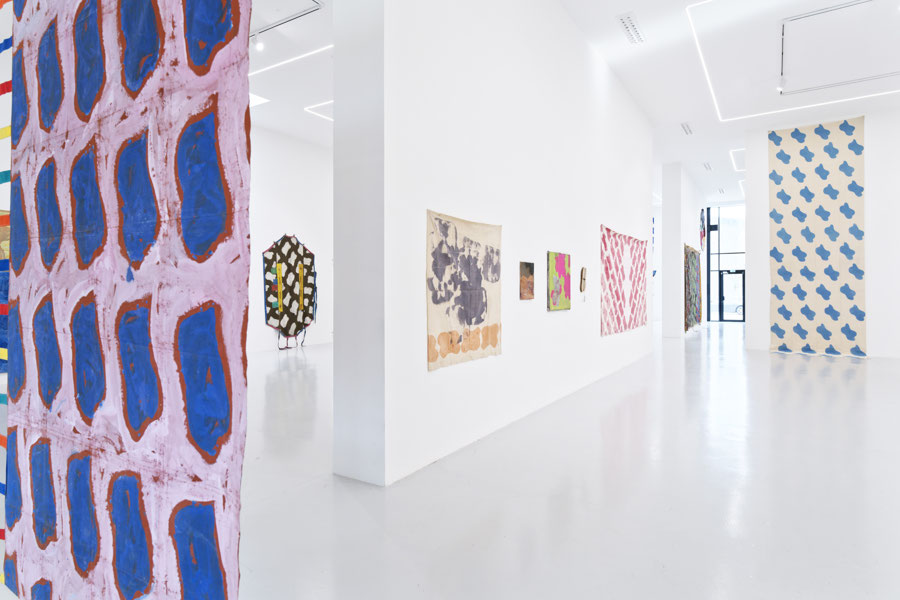
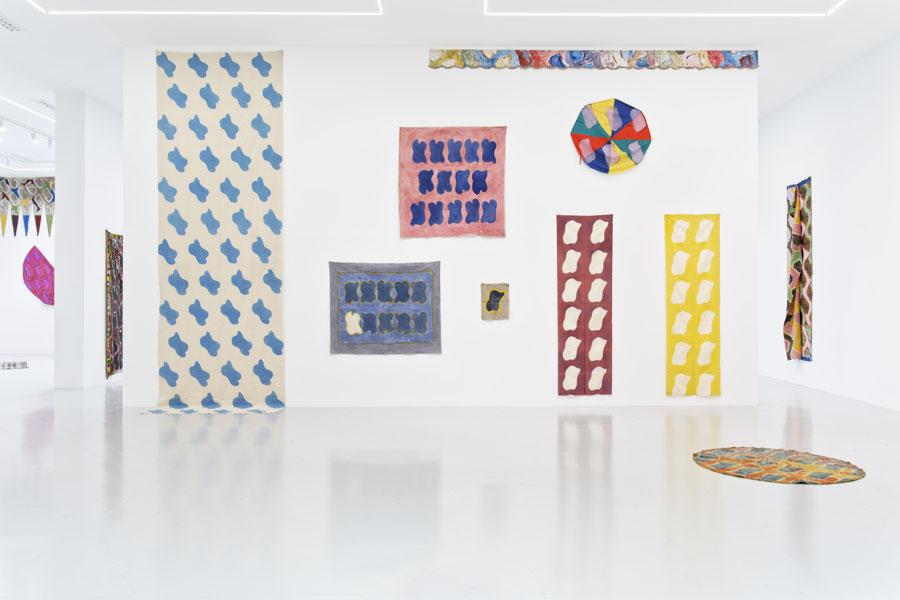
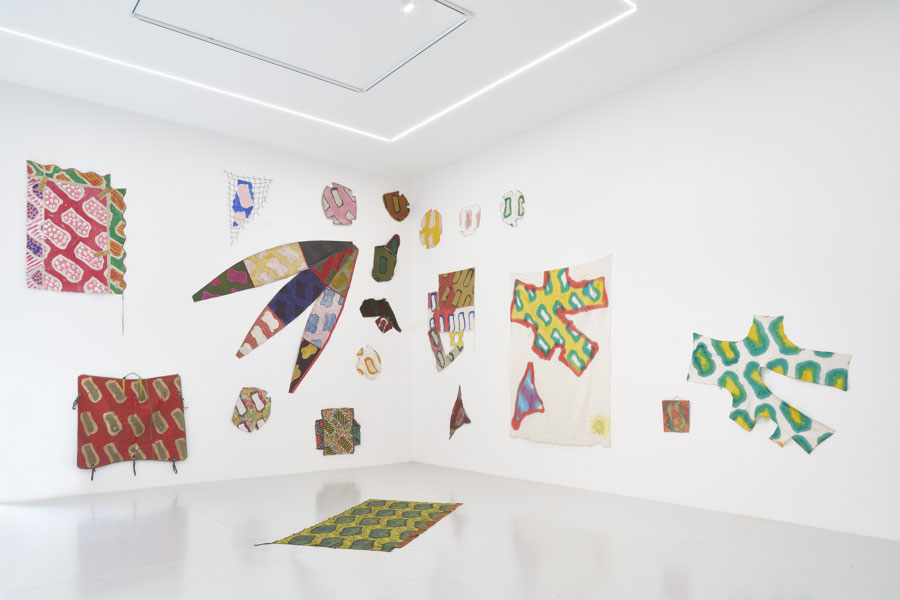
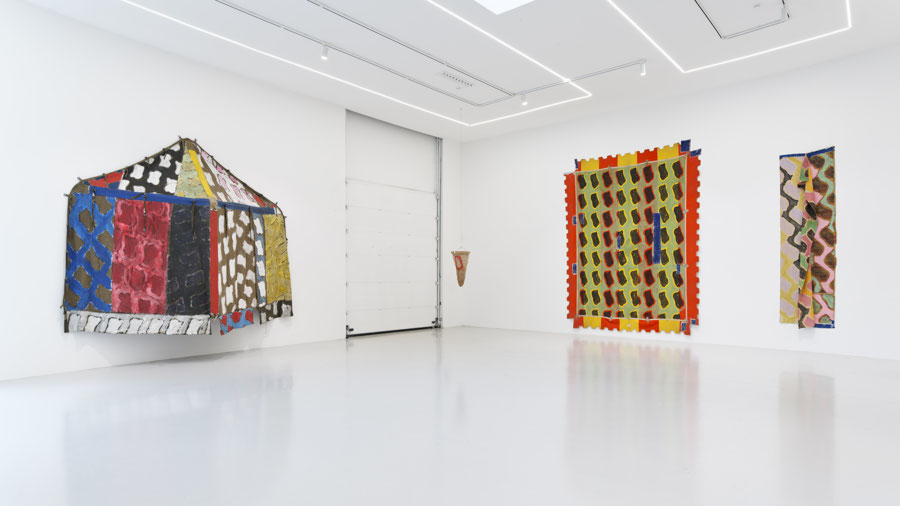
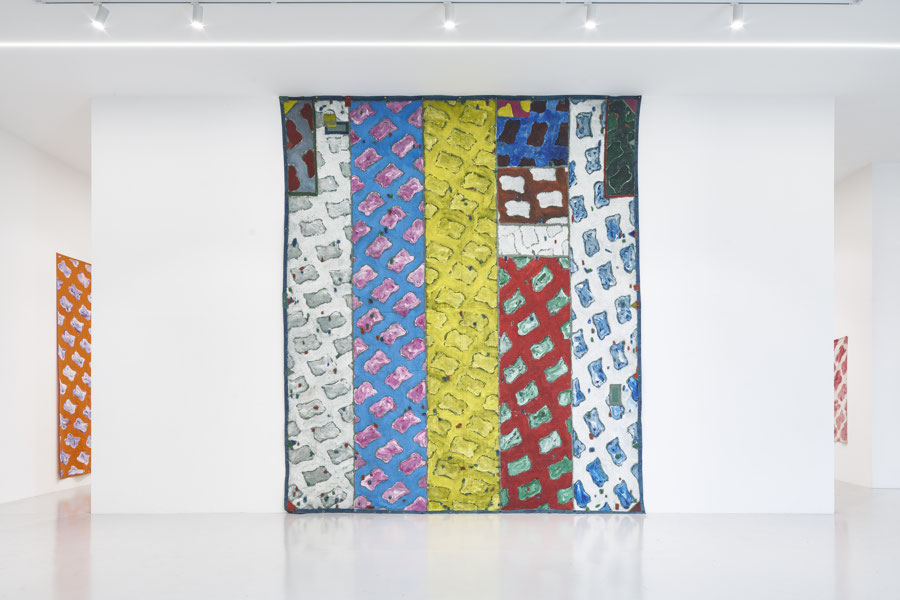
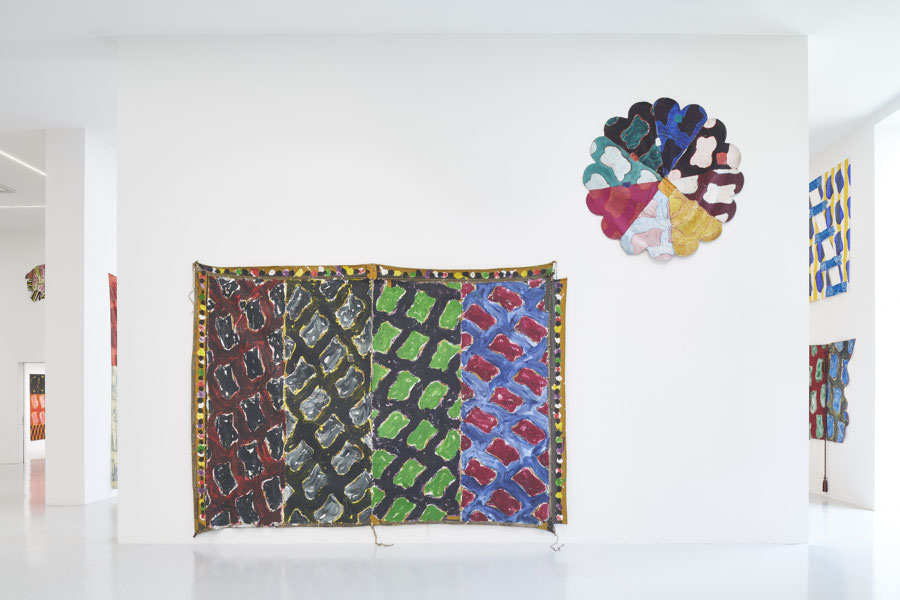
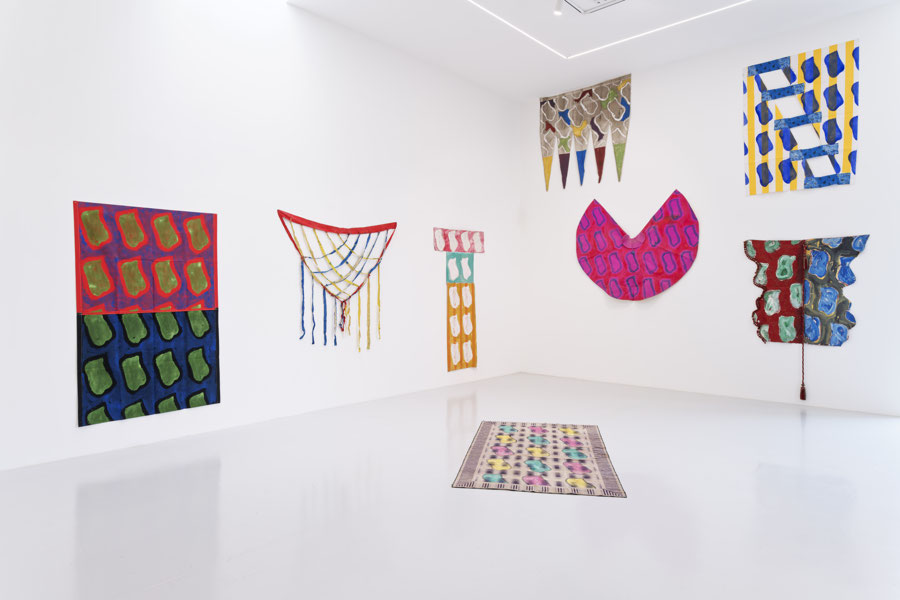
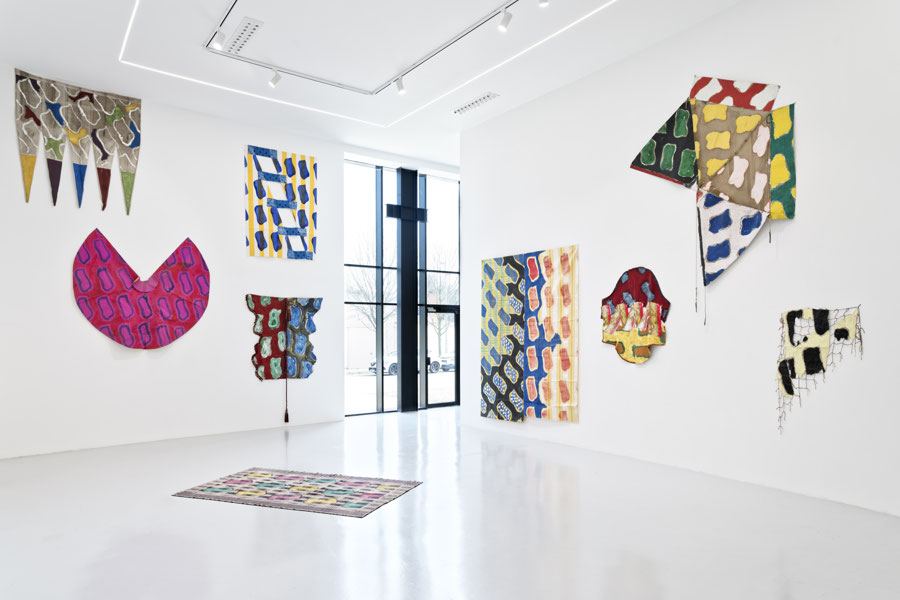
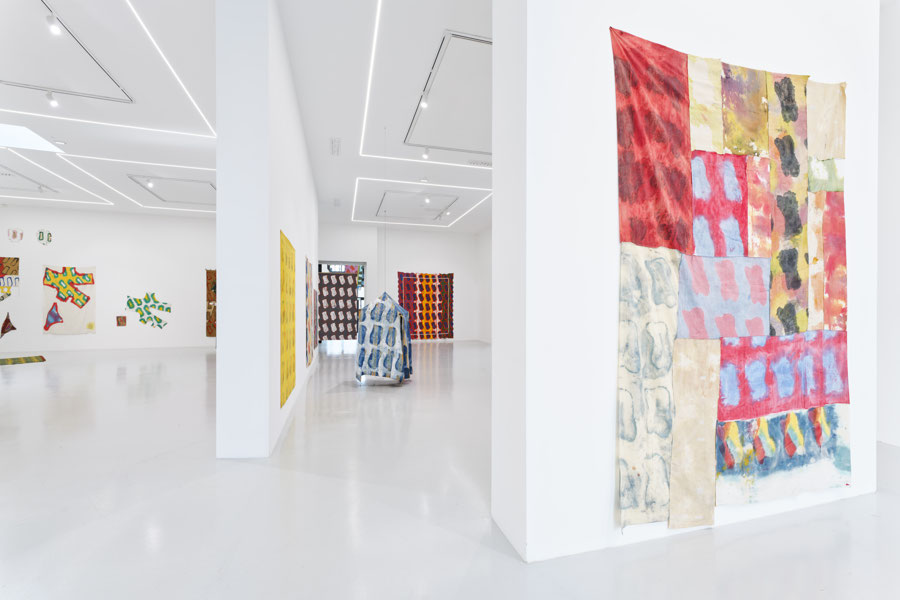
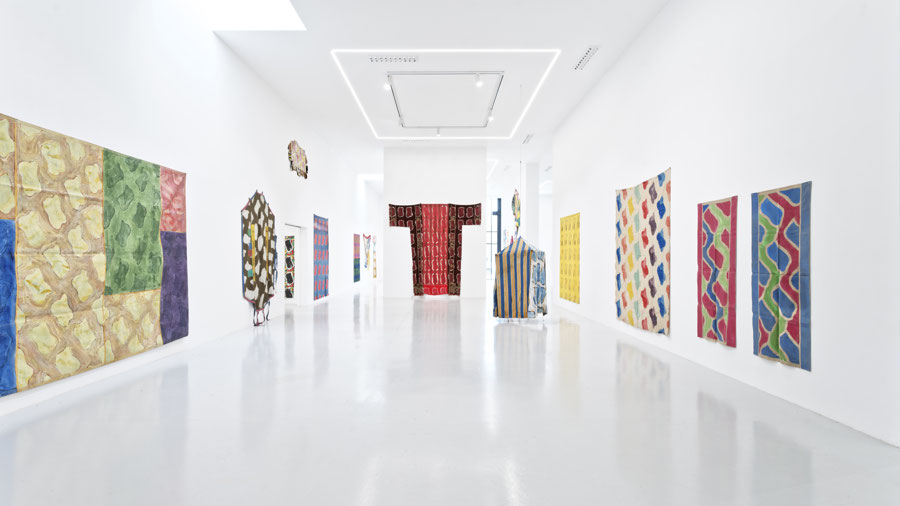
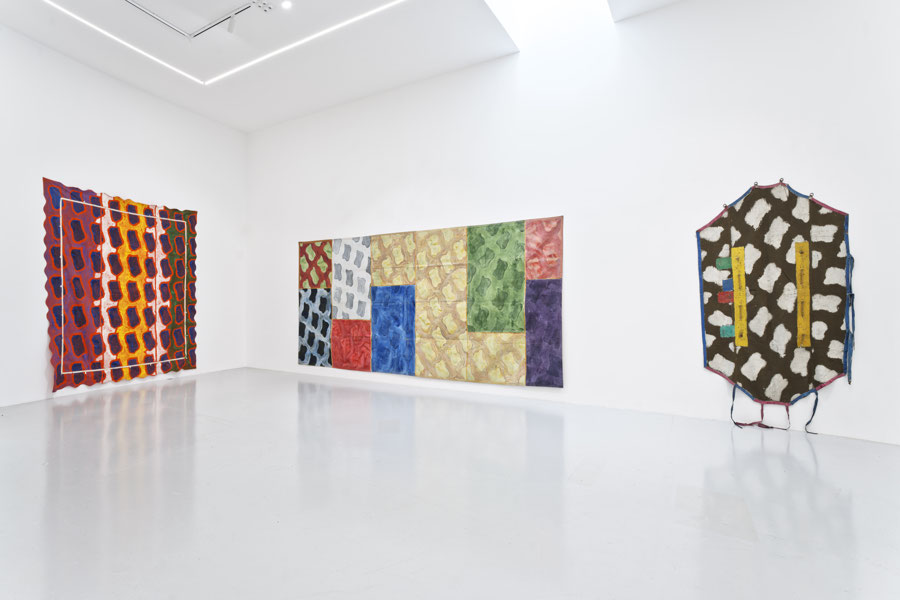
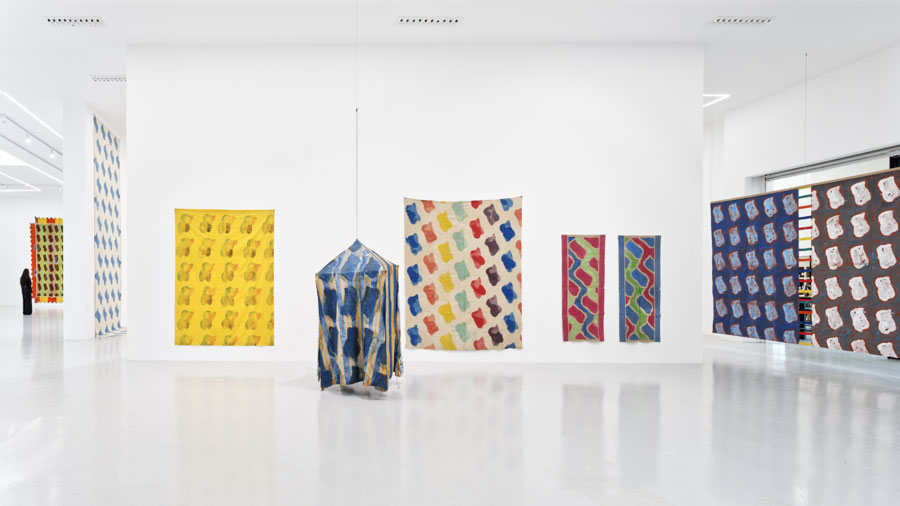
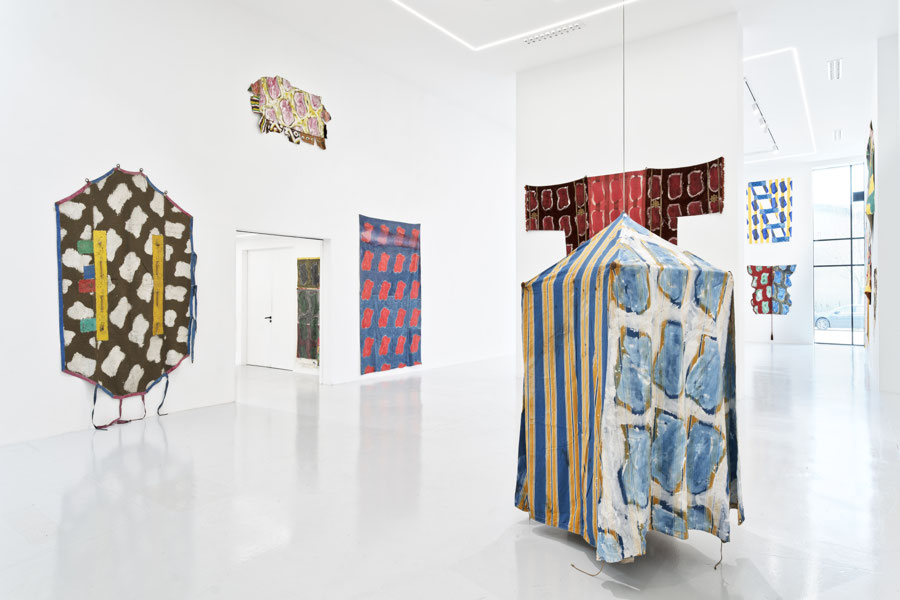
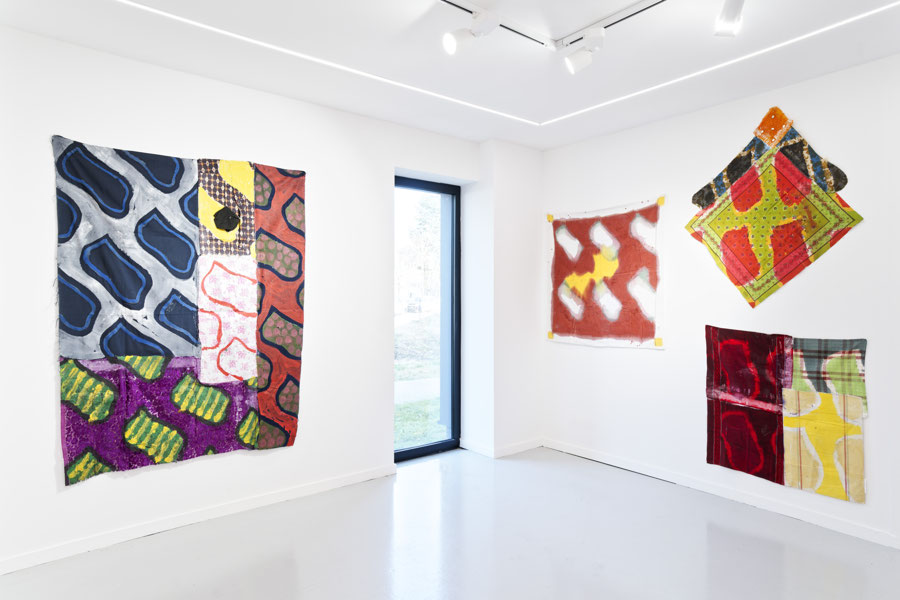
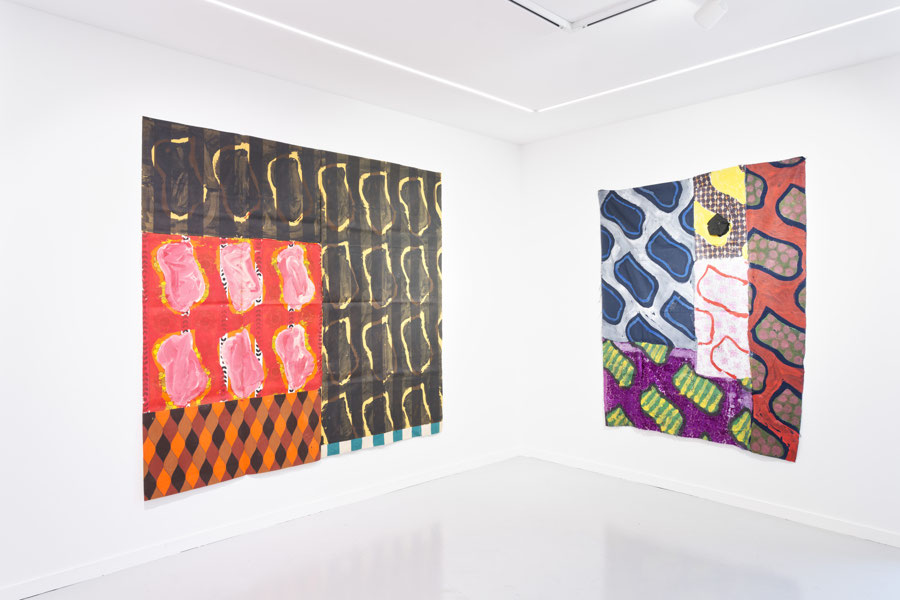
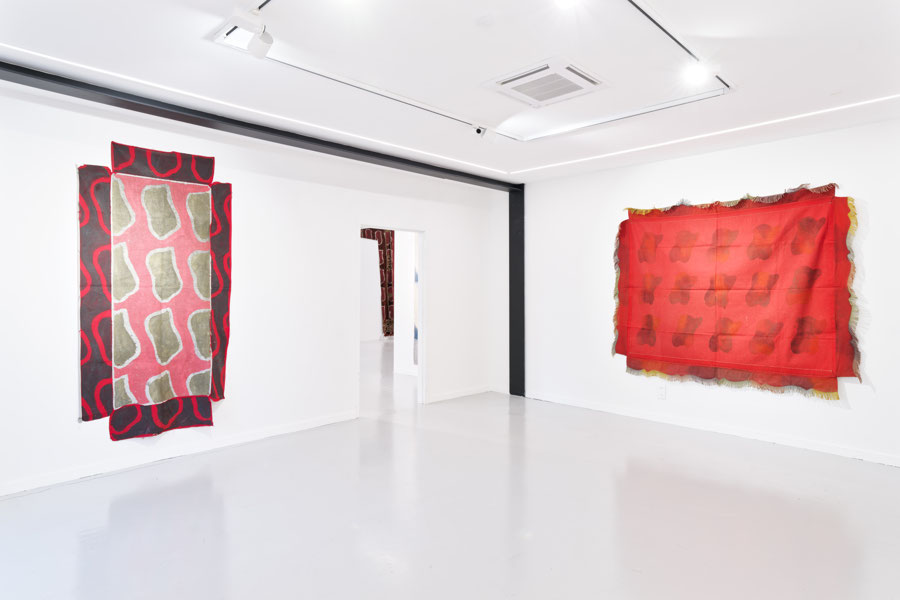
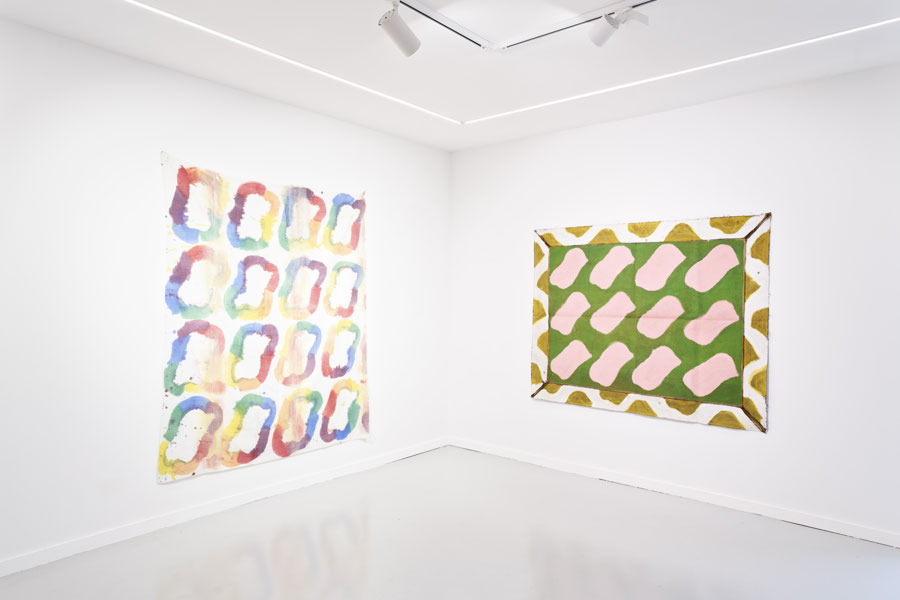
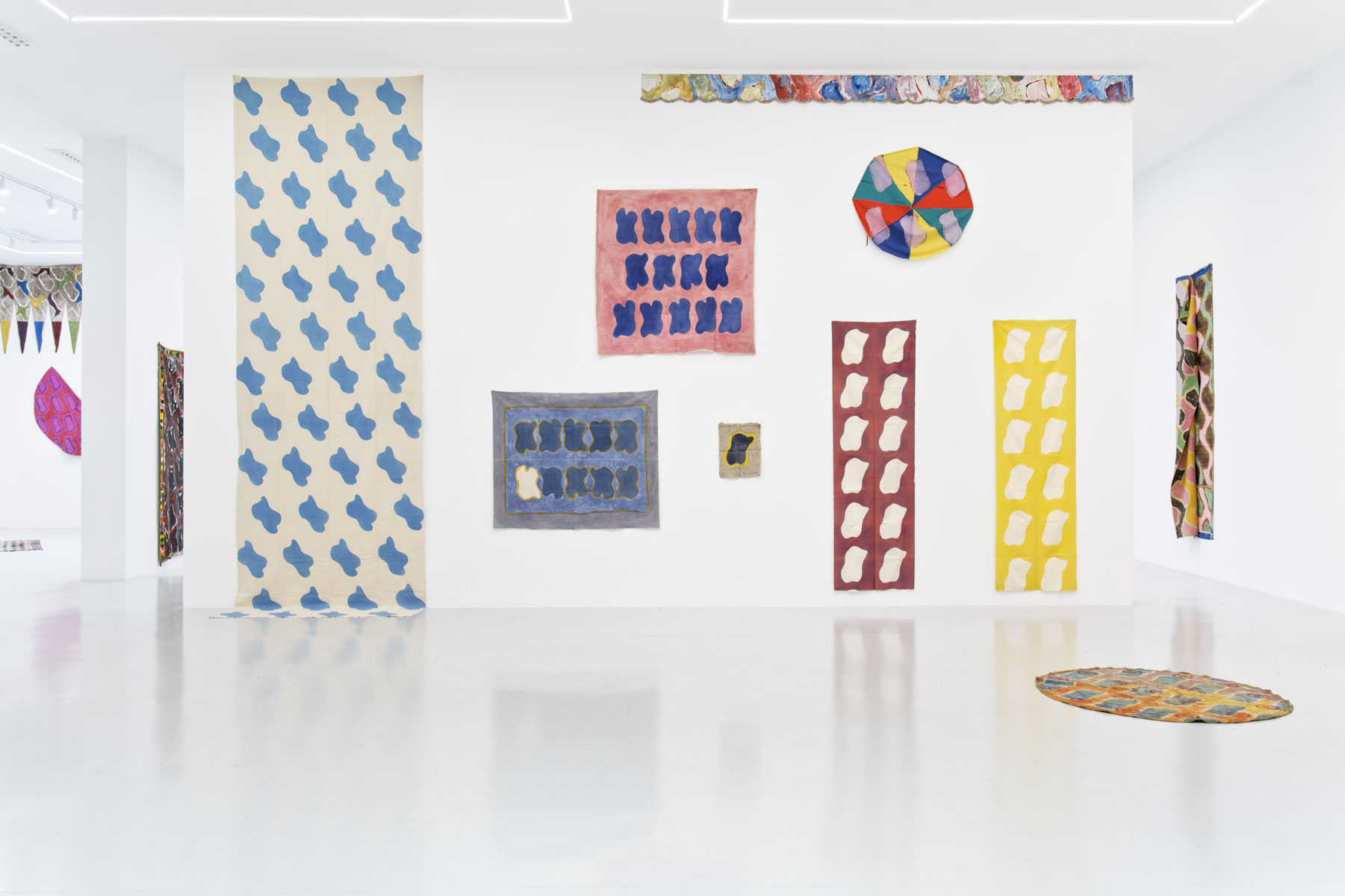
To celebrate its 20th anniversary, the Ceysson & Bénétière Saint-Étienne gallery is presenting an exhibition from 6 March to 23 May 2026 tracing the 60-year career of Claude Viallat, the first artist exhibited by the gallery in the same city 20 years ago.
Claude Viallat : His Form is sixty years old
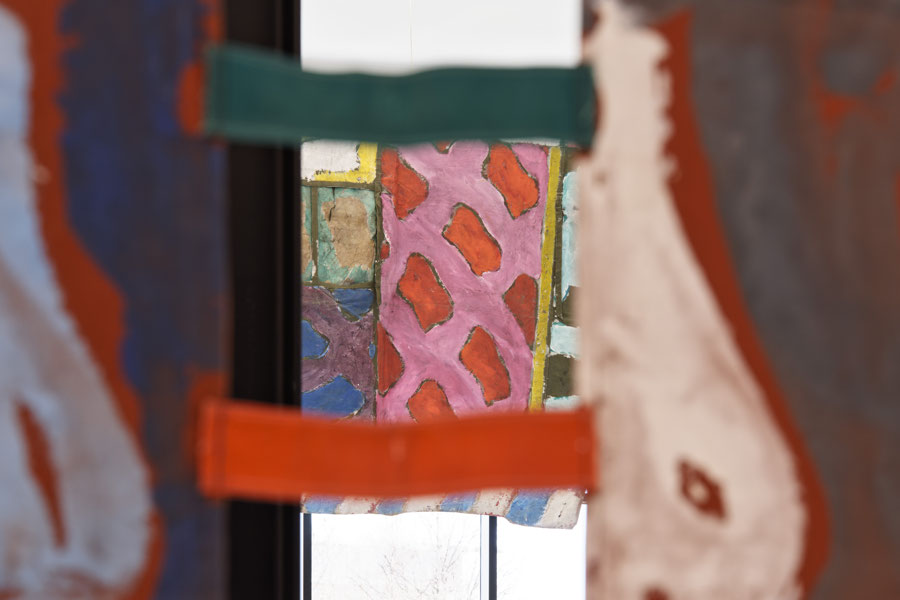
This is a themed exhibition. And yet, it cannot truly be one. Perhaps it is time to stop rehearsing the canonical narrative of Supports/Surfaces. Perhaps it is time, instead, to consider the mediums themselves: printed furnishing fabrics and fashion textiles. Perhaps it is time to focus on tarpaulins, major protagonists of urban economic activity: military tarps, truck covers, café awnings, sunshades protecting homes and shops. If someone undertook that study, it would undoubtedly reveal the extent to which Viallat’s art is embedded in everyday life. By diverting these various fabrics - once worn, discarded, relegated to the refuse and debris of urban existence - and painting them, stamping them with his unfamous motif, as a statement within the sphere of artistic production and consumption, the artist aestheticizes them together with their past, their lived experience and their history. In doing so, as Walter Benjamin had wished, he confers upon his art a political dimension while carefully refraining from aestheticizing the political. Such a study would quickly demonstrate the necessity and urgency of more rigorous and in-depth investigations into Viallat’s motif itself. This motif is the active, transformative agent that Claude Viallat devised in order to “change art”: to re-energize a faltering modernity and open a breach within an art system running out of breath.
This is the light the present exhibition wants to shed, by foregrounding works produced with and through this motif, from 1966 to 2026. One, two, sometimes three “canvases” for each of these sixty years will show that, repeated over and over, this motif informs every occurence - none of which is exactly the same - shaped and painted using two types of stencils: one solid, one hollowed out. The choice of one or the other entails a pictorial process grounded in a similar practice. Yet it leads the artist to adopt a specific mode of execution. As such, each form, resembles an imprint, a mark, whose origin might be traced to the iron branding of conscripts with their class year, initially used to mark bulls in the manades, and on the doorframes of rural Occitan houses. Numerous texts have emphasized the countless variations of this matrix, source, ideal and conceptual motif. Yet there was indeed an initial form, a “prime object,” to borrow George Kubler’s term. Its proliferating nature has often been noted, as have its inexhaustible paradigmatic variations. And yet, there seems to be no way of establishing an evolutionary chronology, since these variations ebb and flow according to the artist’s will. In short, the evolution of the motif, or rather, of motifs, is not Darwinian. Would it therefore be futile, or unfounded, to propose a classificatory typology?
The motif has been likened to a knucklebone, a bean, a stylized bull’s body, a conjoined bull and female body, and, of course, a sponge. None of these analogies is dismissible. Yet none is entirely satisfactory. The symbolic meanings and interpretative games these suppositions have injected into the motif are neither to be rejected nor overlooked nor concealed. And yet they are not sufficient. Are they even necessary? For if the motif were a representation of one of the natural organic shapes thus evoked, or even of an artificial one, would Viallat not simply be a realist painter, a designer of patterns for textiles and wallpapers? Like those manufacturers reproducing Boucher-esque gallant scenes for the printing of Toile de Jouy, for example? And yet, one may venture the hypothesis, as I dare to do so, that the singular character of each avatar of the motif ensures that none of the motifs painted by Claude Viallat is merely ornamental. Let us return to the origin. It is the summer of 1966, shortly after the opening at the Musée de Céret of the exhibition Impact, organized by Claude Massé. Claude Viallat is staying in Catalonia, by the sea, with his wife Henriette and their daughters. It had become urgent for him to divest the image of any meaning other than “that of the process which produced it [and] to reduce to the utmost both the system of production of the image and its signification.” The recourse to “a method used to whitewash kitchens in Mediterranean countries seemed appropriate” to him. He describes the procedure as follows: “A sponge dipped in a bucket of blue lime and applied systematically to a white ground.” There seems to be a troubling contradiction in this sentence. In truth, it is merely a revealing amalgamation, almost a “patriotic” synecdoche. For Viallat, the Mediterranean really means Aubais. In Aubais, less affluent inhabitants used to whitewash the walls of their kitchens, the main room of winegrowers’ houses, and then adorn them with blue decorative motifs applied with a sponge or cloth. Or, as Viallat saw Monsieur Mison do, a mason specialized in this technique, using a roller that imprinted a floral motif onto the walls, a repeated one! Claude Viallat inherited Monsieur Mison’s roller, the wallpaper tool of poor men, and it now hangs in his studio. Yet Viallat needed to find a motif of his own. This is how he ended up drawing a “sheet of polyurethane foam, a somewhat palette-shaped form”, as he told us. He dipped it into liquid color and pressed it onto the canvas. One evening, before leaving his studio, he immersed it in a bucket of “almost pure bleach” to clean it. The next morning, when he retrieved it from its bath, it had torn into shreds. He managed to salvage the largest piece, a shape he would go on using in all his subsequent work, “a chance form, given by accident, as good as any other.” Reading this story, one cannot help recalling the “Kandinsky legend,” in which the painter, returning home at twilight, discovered “a painting of indescribable beauty, imbued with a great inner ardor.” It laid “on the floor, upside down.” The “Kandinsky legend” and the “Viallat legend” share the same narrative structure; yet Viallat, who had not read Regards sur le passé at that time, inverted the elements of Kandinsky’s famous anecdote. This initial motif, as first applied to a canvas, was “oblong and vertical”, Viallat insisted. This creation, or re-creation, of an origin that Viallat was determined to produce in 1966 implies the design of a “moment,” whose heavy knots of thick marine rope, obviously reminiscent of Leonardo’s knot studies, would soon suggest the possibility of “indexing” into series. Thus, the artist enclosed a small canvas from 1970, bearing a single colored motif in distinct blue and white – hence manifesting its physical incompletion despite a firmly drawn violet outline - within a thick border that anticipated its enlargement. Might it resemble, as it tentatively emerges, one of Leonardo’s embryos sketched within the protective “shell” of its placenta? Here I invoke André Chastel and his enigmatic commentary on that surprising, “barely perceptible” detail in Leonardo’s Saint Anne: “One discerns [within an arid, mineral landscape], a tiny embryo, among the stones beneath the big toe of Saint Anne’s right foot, like a clot of blood.” Chastel adds that “the long ascending perspective of the landscape and the rapid fading of the distances” enhance “the ochre and green harmonic of nature conceived as the realm of the metamorphoses of earth and water.”
The only chronologically situable evolution of the motif began as early as 1966. One of the earliest occurrences resembled a knucklebone, but very quickly, it simplified and became the organic motif which, in this case, is indeed “a protagonist.” Claude Viallat himself recently used this term. A protagonist whose stories remain to be written. Is Claude Viallat, then, a realist painter? A naturalist? A figurative artist? Is the motif, in each of its variations, merely a visual tool applied like a banal and pleasingly decorative ornament?
The suppression of the stretcher was a bold decision. What we metaphorically designate by the word “canvas” - a painting on canvas - truly became one. Restored to the literal truth of the term, freed from its rhetorical function. We owe this restitution to Daniel Dezeuze, who was wary of seeing his art confined to the specialization implied by the oft-repeated distribution of roles Viallat attributed to the “inventors” of Supports/Surfaces: “for me the canvas”, “for Dezeuze the stretcher,” and “for Saytour the imprint of the stretcher on the canvas.” Apparently, Viallat paid little attention to the stretcher. He dispensed with it, invoking tangible economic necessities. The canvases became foldable, less costly to store and transport. The economic imperatives shared by the artists of the group, particularly those living in the countryside, has not been sufficiently emphasized. It should be noted that the early works of Viallat, Saytour, Dolla, Valensi, Arnal, and Pincemin could still be mounted on stretchers. Daniel Dezeuze, for his part, replaced canvas with a thick transparent plastic film stretched over a stretcher stained with walnut husk, objectifying, in an illuminating and subversive ostension, the exploitation of its conventional and intrinsic meanings. Vincent Bioulès and Marc Devade, meanwhile, continued to nail the canvas onto the stretcher. They did so to stand out and because their “finances” allowed it: their production was not the invasive, quasi-manufactured dumping imagined by Claude Viallat to blow up the art system. They kept doing it for other reasons as well. As for Claude Viallat, he often pointed out both the disappearance of the stretcher in his production and the presence of its - perhaps tutelary - shadow in the coloration of the seams of certain square or rectangular fabrics. In the case of rectangular sunshades, he has done so, and sometimes still does, by highlighting their seams with color and emphasizing the scalloped edges of their valances.
For Viallat, folding the canvases does not merely obey economic necessity. It virtually replicates the Albertian grid, thereby calling it into question. Hung on the wall, the canvas produces a slight – schiacciato - relief effect disturbing the planar and flat obsessions of Clement Greenberg’s followers. Let us not forget that the “nature” of certain media - meaning the functional surface and cut - forbade their being fixed onto a tense structure such as a traditional stretcher.
In the most recent canvases Viallat painted in January 2026, the blurring of tracks reached what I would call its “unsurpassable” point. For this series of works, he painted on a previously used linen sheet, in hues of white or natural ecru. Claude Viallat laid it out on the floor, then placed another piece of fabric upon it, tracing the outlines of its cut onto the sheet. On this superimposed cloth, he painted the outlines of the motifs that could be positioned there. Their drawing “capillarized,” seeping into the surface of the sheet and into its very texture. Viallat then filled these motifs with paint, as well as those printed on the impregnating fabric, which he colored differently. Visually, the result produced an effect of collage that replaced patchwork, an illusion of montage and of superimposed planes. What we see has indeed taken place, yet it can be apprehended only after we have been informed of the modus operandi. This procedure is the result of a painful event that abruptly broke and fractured a temporal continuity of time. The time that Claude Viallat inhabits is lived time, unfolding in the succession of seasons and days. It is the time of the craftsman, of the gatherer, of the hunter. It is cyclical time, adjusted to a sort of “canonical” rhythm punctuated by ritual actions parodying the main canonical hours. It is the idealized time illustrated in the illuminations of The Very Rich Horrs of the Duke of Berry. As such, these recent works stand at an inevitable hinge between those hours and that of universal time. So that the enigma may endure?
Here, I have merely skimmed the surface of a question scarcely touched upon. It becomes quickly evident that the placing of motifs upon worn fabrics refers back to the origins of the form, to the origins of art itself. In this way, Claude Viallat vigorously shakes the coconut tree of modern art and of modernity. The making of each canvas turns him toward Prehistory, his own prehistory, toward a primitivism that never truly was, yet which he made his. He has imagined it, shaped it, constructed it, both parallel and opposed to the predatory primitivisms of Western modernity. Thus Viallat has engaged his art in a circulation, a gathering, a harvesting across all the “moments”, which Focillon called the “swellings” of art history, drawing from everything that may be connected, adapted, “naturalized” within his own quest for painting as truth. In the sense that certain authors have applied the notion of pastiche to Picasso, Claude Viallat is indeed a pasticheur. His recent works confirm this, as they summon and appropriate the figurative dispositif of Matisse’s Red Studio. As a result, all the forms applied on woven media, and every motif stamped on them, are transmuted into pictorial objects characteristic of the art practiced by Claude Viallat. They prove to be neither ornamental nor figurative. Nor are they abstract. Simply real. Pictorially true. Within each media, each motif displays and imposes its presence; each time, it integrates itself with the surface and its materiality, until it becomes, perhaps, nothing more than a sign. In each of its avatars, the motif thus affirms and proclaims its function: to ensure the intensity, the saturation of color. It is through its proliferation as a mark and a blazoning motif that it both is and is not; through its quasi self-generation; through its chromatic punctuation, sometimes assisted by the underscored by the counter form’s marking, that Claude Viallat’s produces that suspension which holds us motionless before its face. We are indeed seized, and at the same time elevated by these deliberate, conscious, and accomplished surpassing, by the vertigo into which the art of Matisse, among others, once carried us. And into which the unique art of one of the greatest colorists of all time now transports us. Claude Viallat!
Bernard Ceysson