“I am figurative because I live in a world of reality. However, the message of my paintings is completely abstract—an attempt toward a universal language.” — Robert Combas
Emerging in the late 1970's amid a broader return to figuration, Robert Combas quickly established himself as the central figure of what would become the Figuration Libre movement. Revealed in the exhibition Après le classicisme at the Musée de Saint-Étienne, then associated in 1981 with Hervé Di Rosa, Rémy Blanchard, and François Boisrond in Finir en beauté under the impetus of Bernard Lamarche-Vadel, he brilliantly embodied the desire to reintroduce the figure, color, and narrative at a moment dominated by conceptual and minimalist aesthetics.
Robert Combas’s work far exceeds the historical framework of the movement: it belongs to a broader enterprise—that of a continuous image-making practice. For more than forty years, the artist has produced daily figures, scenes, faces, battles, loves, monsters, and hybrid heroes. He does not merely represent the world; he generates his own icons—immediately recognizable, proliferating, saturating the pictorial surface until it becomes an autonomous territory. Influenced by rock’n’roll, comic books, and the popular signage observed in Sète or in the culturally mixed neighborhoods of Paris, as much as by the history of painting, he has invented a complex iconography in which high and popular cultures intermingle without hierarchy. Ancient mythologies, news items, historical episodes, television serials, and references to the Old Masters coexist within the same vibrant space. Anything can become an image. Anything can become a sign.
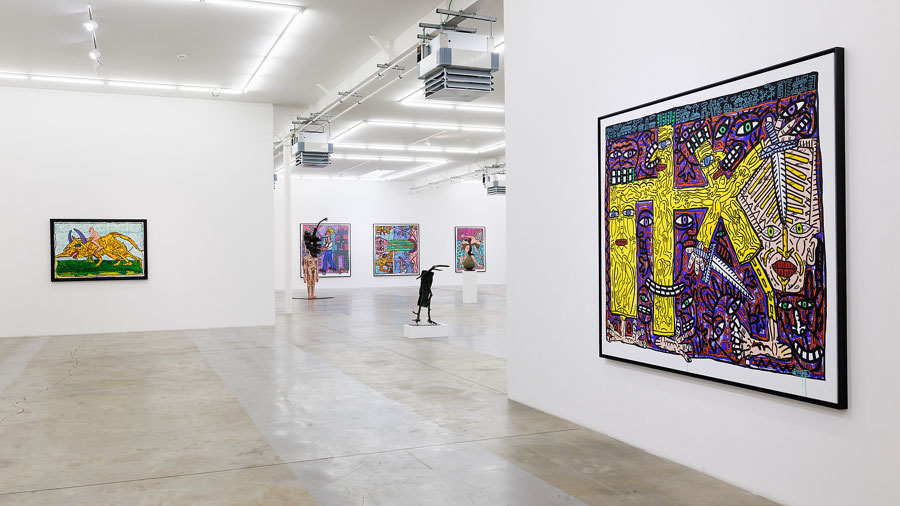
Beyond the narrative stakes, Robert Combas has developed a true visual language—an alphabet entirely his own. The black line outlining forms, the bold contrasting colors, and the ornamental density compose a syntax that is instantly identifiable. Figures interlock, overlap, and invade every interstice. The surface becomes pulse, saturation, intensity.
Text also occupies an essential place. Long titles, poems, rhymes, and commentaries are inscribed within or around the canvas. Combas cultivates displacement, humor, and self-derision, verbal excess, and the musicality of words that extend the painting, contaminate it, and sometimes blur its meaning in order to open a space of exuberant exploration. Each canvas functions like an expansive sentence in which bodies, motifs, and letters assemble according to an internal grammar. The artist speaks in images, and these images—repeated, transformed, combined—form a singular vocabulary.
The fertile paradox of his work lies in this constant desire to measure himself against the history of art, experienced as legend, while injecting into painting the raw energy of everyday life and popular culture. Behind the apparent insolence unfolds remarkable virtuosity and compositional mastery that makes each canvas a total space.
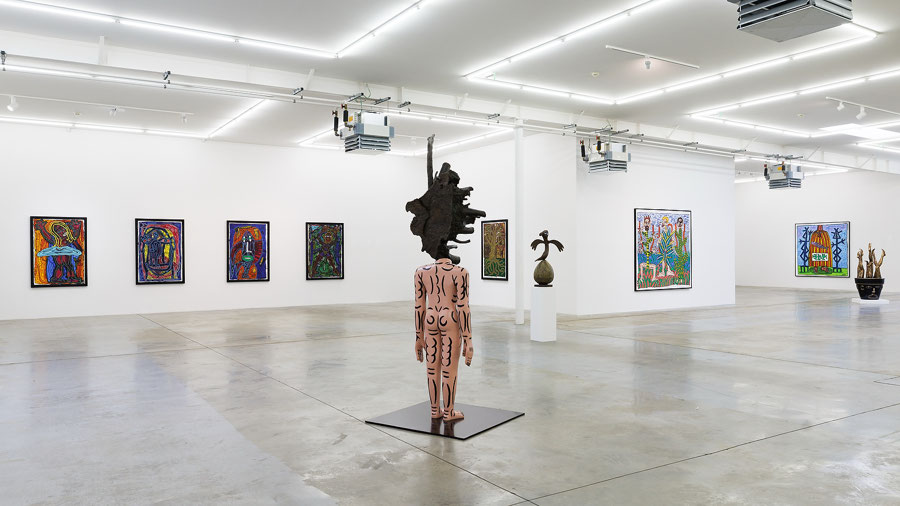
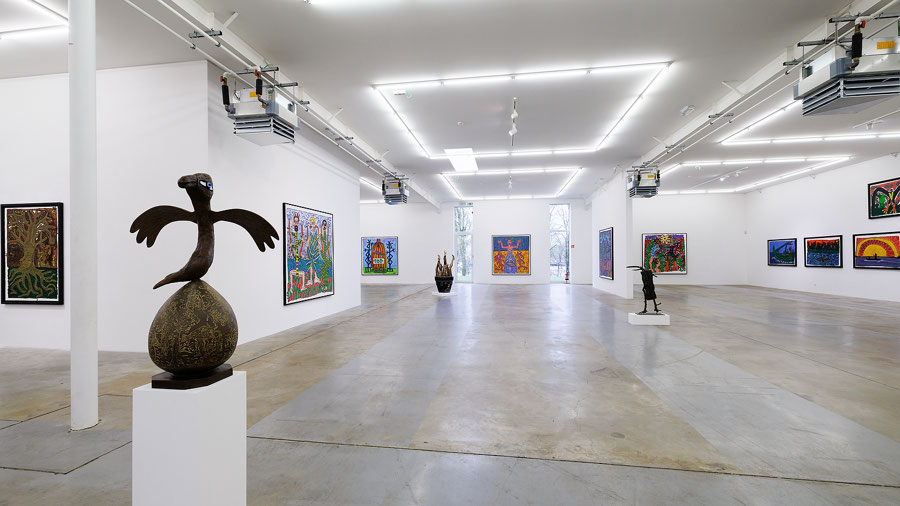
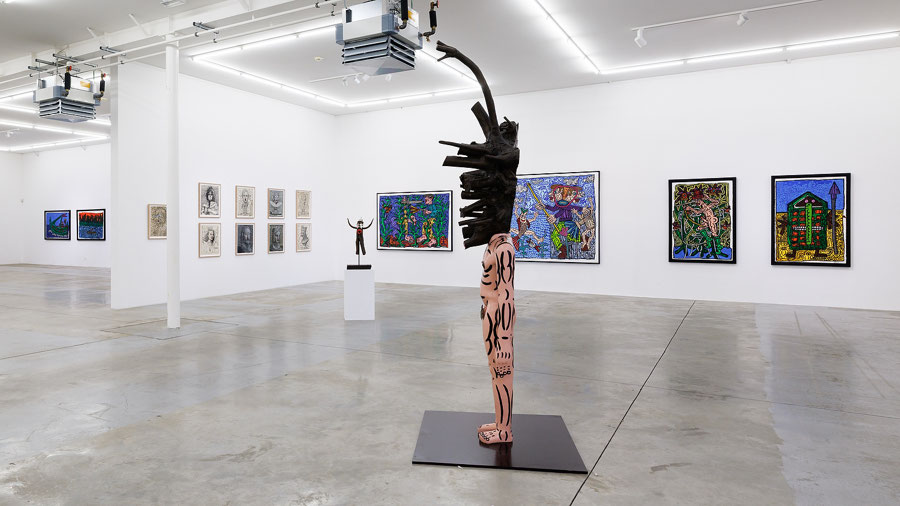
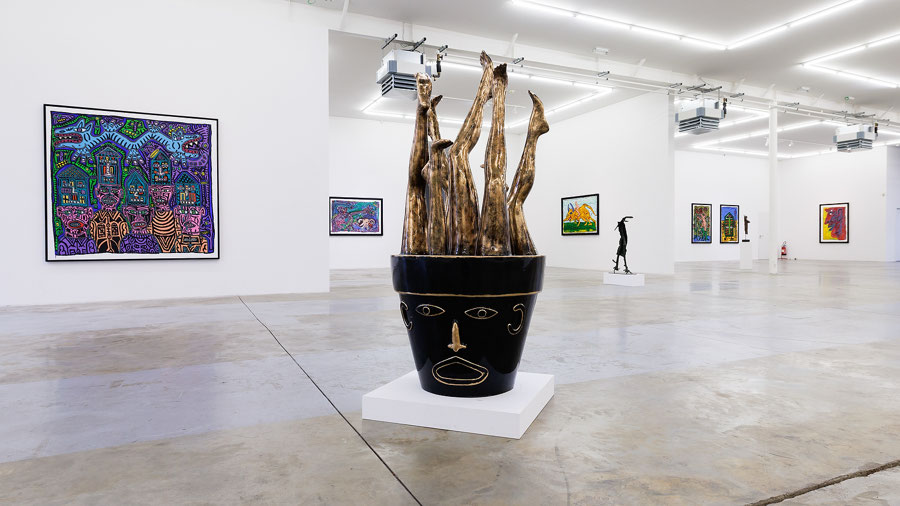
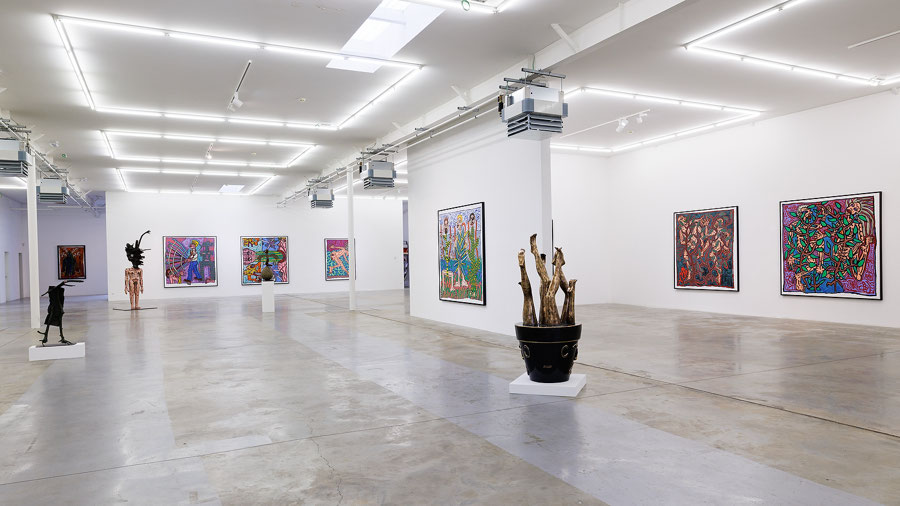
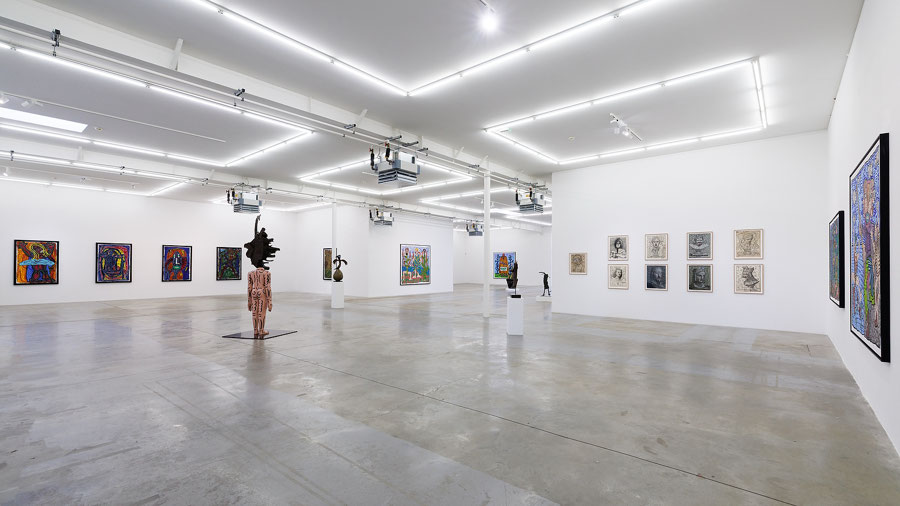
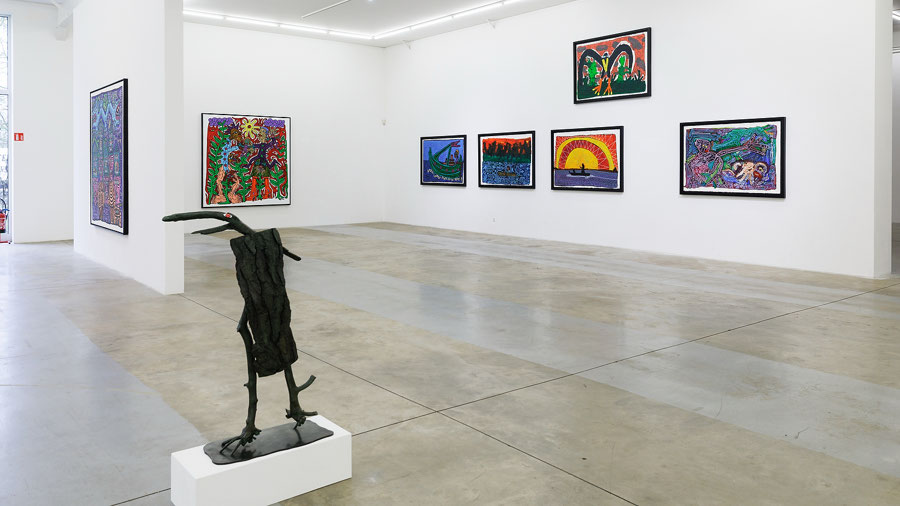
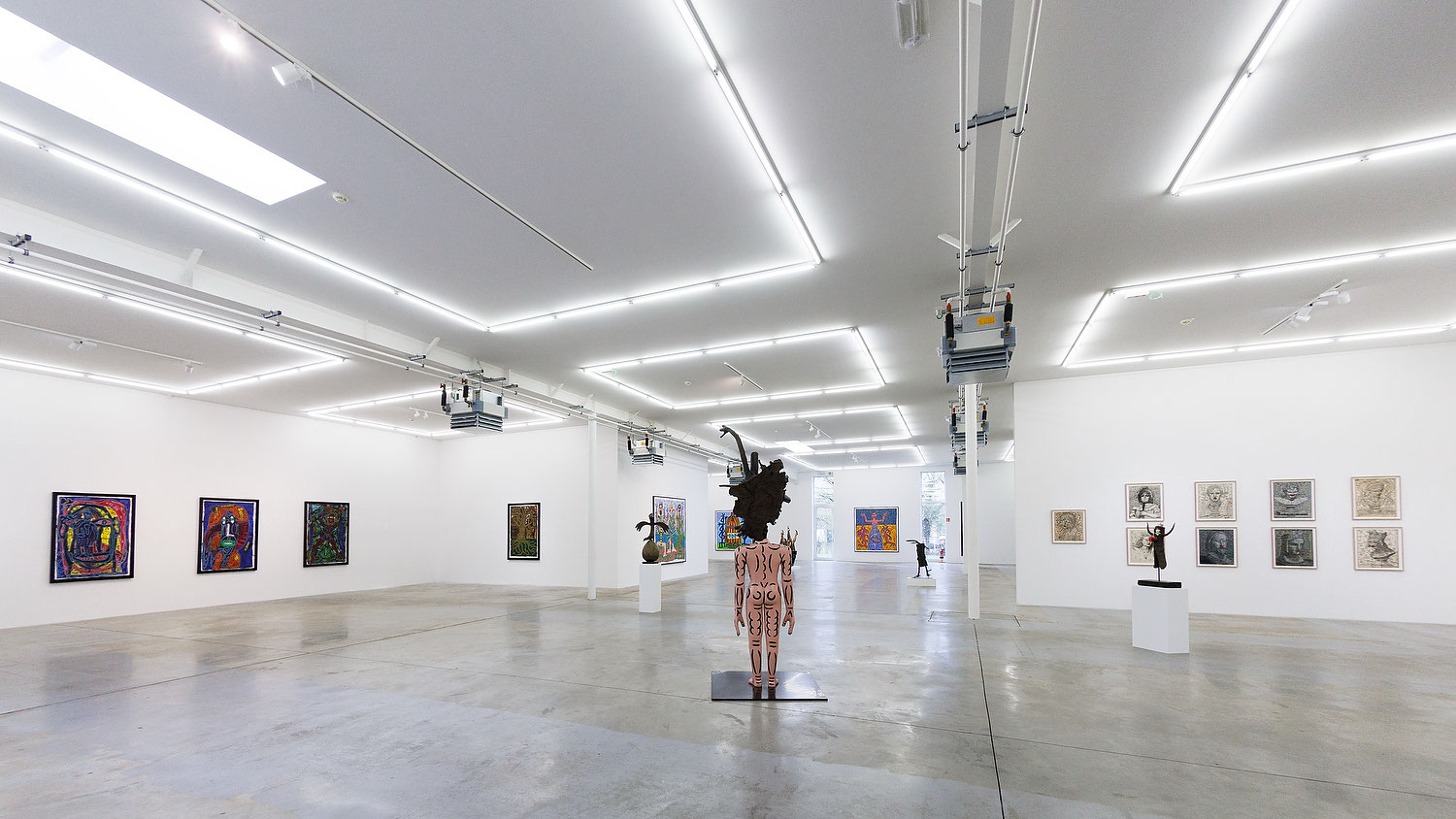
This show presents large paintings on canvas in which the immersive power of his universe unfolds. House Men but “in meeting,” Mediterranean Goddess with Snakes, Watering Fisherman,and Projection of Lances in All Directions assert themselves with monumentality. These large-scale formats (200 × 200 cm) are complemented by an important corpus of paintings on Arches vellum paper, where the gesture—more immediate still—reveals the fluidity of the line and the dexterity of execution, like a thought unfolding in real time. The Solitary Sailor, Free Flowers, and The Longaunet Warrior are among these works on paper in which the artist’s gesture and material transform.
A group of Academic Tattoos completes the presentation. This series occupies a singular place in the artist’s trajectory. Starting from preexisting academic drawings—studies of nudes and figures from the classical tradition—Combas intervenes with line, literally “tattooing” the original image. This act of reworking, initiated in the 1990s, constitutes an almost conceptual practice through which the artist reactivates an inherited image, inhabits it, and contaminates it with his own visual alphabet. The academic drawing, symbol of a codified and normative tradition, becomes the support for a free appropriation. By tattooing these figures, Combas inscribes his language onto the very body of art history.
Finally, a group of very recent bronze sculptures further enriches the exhibition. The Prehistoric Flamingo and The Horned Specter in bronze enter into dialogue with a Man with a Head of Branches. Robert Combas the sculptor fully embodies the free artist he is.
The exhibition at Ceysson & Bénétière highlights the painter’s work as a vast system in expansion—a factory of images that has become a world, an iconic and linguistic universe where figuration, far from being illustrative, becomes the vehicle of a universal speech. Painting as one plays rock, but also as one writes—inventing, day after day, the signs of a personal semantics.