The elephant, in the course of time, has adopted man into his scheme of things, with deep distrust.
-Karen Blixen (Isak Dinesen), “Shadows On The Grass”
Peter Beard: The Scheme of Things presents a rigorous selection of key works executed between 1960 and 1977, a period defining the artist’s transition from the authoritative, singular image to the dense, tactile assemblages of his later work. Whereas previous exhibitions have tended to focus on the ecosystems and social hierarchies in front of Beard’s lens, this show serves as a roadmap charting the surfaces' transition into ecosystems in and of themselves.
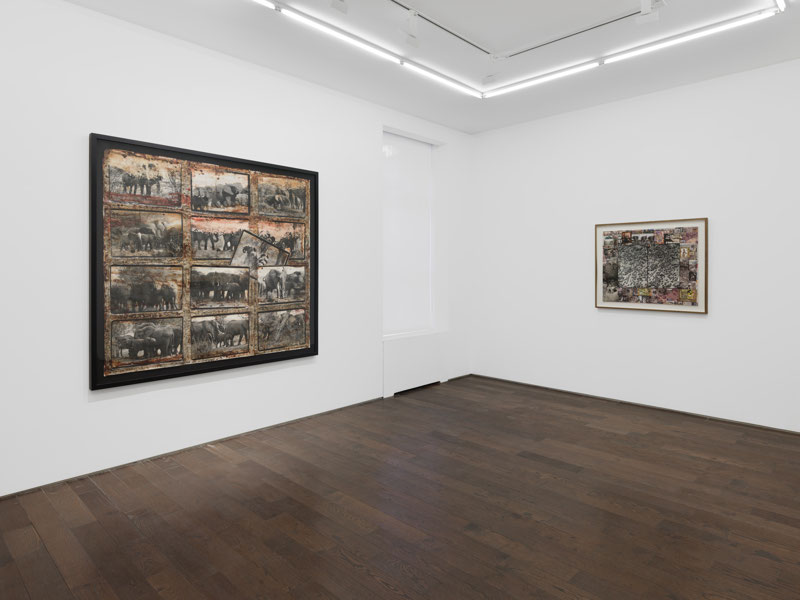
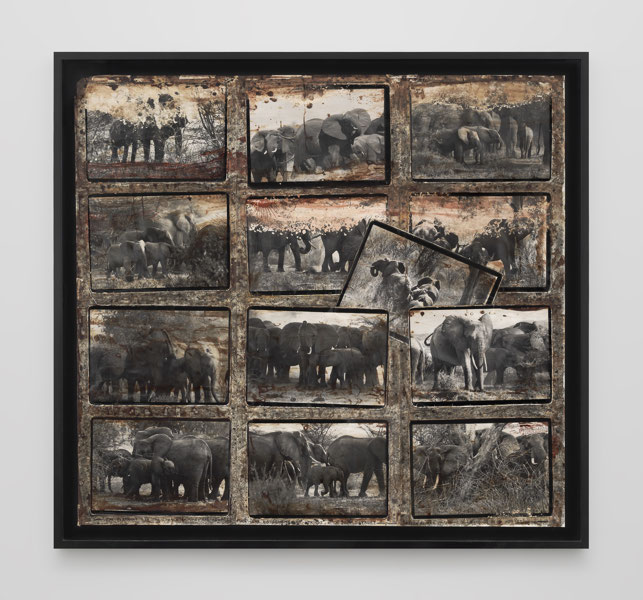
The exhibition is anchored by a rarely exhibited, monumental masterwork from 1977, The Elephant in the Course of Time, annotated with the quote from which this exhibition gets its title. Featured in Beard's groundbreaking exhibition that same year at the International Center of Photography, this expansive elegy documents the intimacy between an elephant calf and its mother. Reflecting his tenure at Yale (1957–1961) under the Bauhaus master Josef Albers and architecture historian Vincent Scully, this maternal narrative is scaffolded by a monolithic grid of twelve gelatin silver prints which echoes the herd’s own formation and fully consumes the viewer. The rigid, serial geometry of the grid is disrupted by an additional image, which juts from center-right and transforms the artwork into an energetic register of immaterial forces like stress and memory. While his work employs the tools of documentary photography to catalog the African landscape, it functions fundamentally as a forensic site where the image acts as a skeletal frame for an accumulated, layered consciousness. Beard’s surface here is assembled, dynamic, evolving, and inhabited, positioning himself, the artist, as a “relational steward,” and not as an authoritative protectionist, mirroring shifts in the environmental movement happening in parallel.
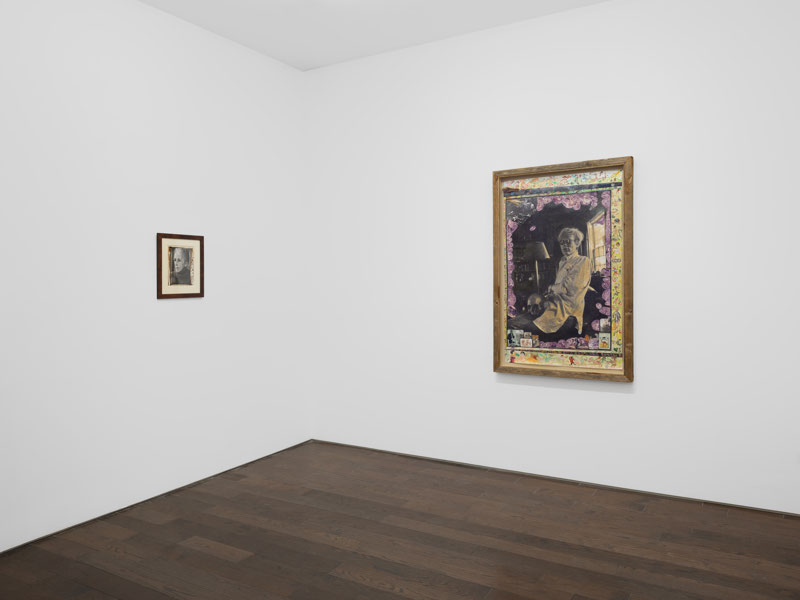
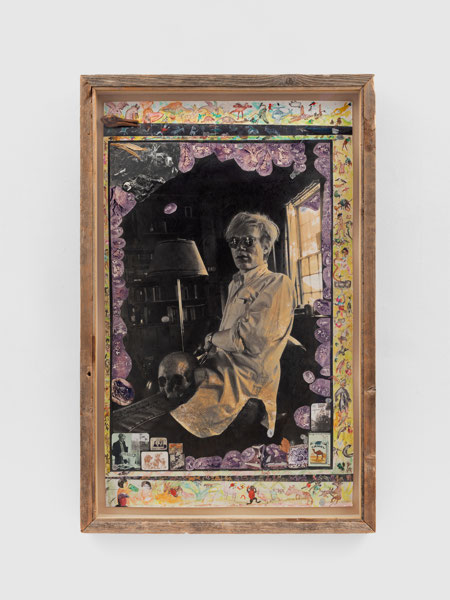
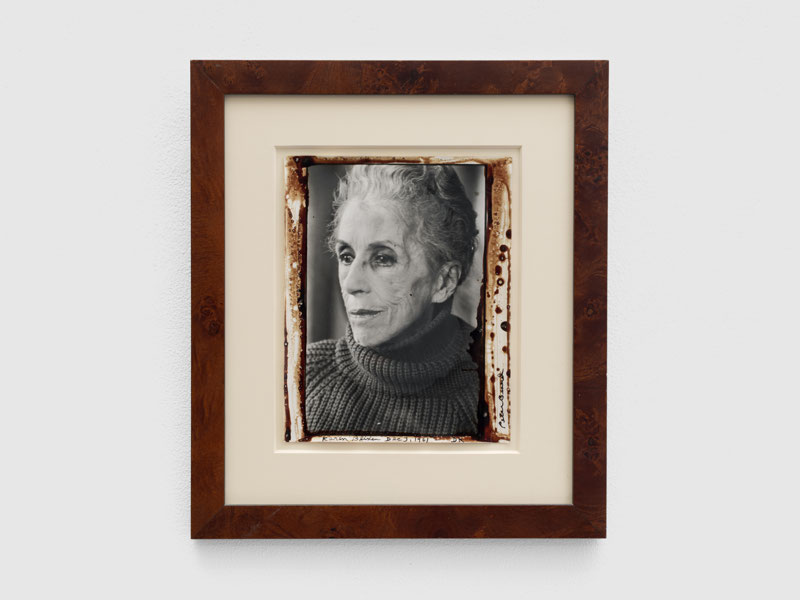
In his portraits of figures like Andy Warhol and Karen Blixen, Beard bridges disparate worlds by framing his subjects within intricate borders of marginalia, news clippings, and animal blood. For Andy Warhol at Home, Church Estate, Montauk (With Skull Soon To Be Painted), from 1972, a classic memento mori is complicated by found imagery and vibrant illustrations, transforming the portrait into a multivalent ledger of the 20th century’s cultural and social currents. Conversely, the portrait of Blixen utilizes a gestural border of ink and organic matter to honor her as a foundational link to East Africa’s colonial and literary history. In both works, the photograph is no longer a passive window but a stratified archive of persona where the subject’s likeness is fused with the artist’s own archival obsessions.
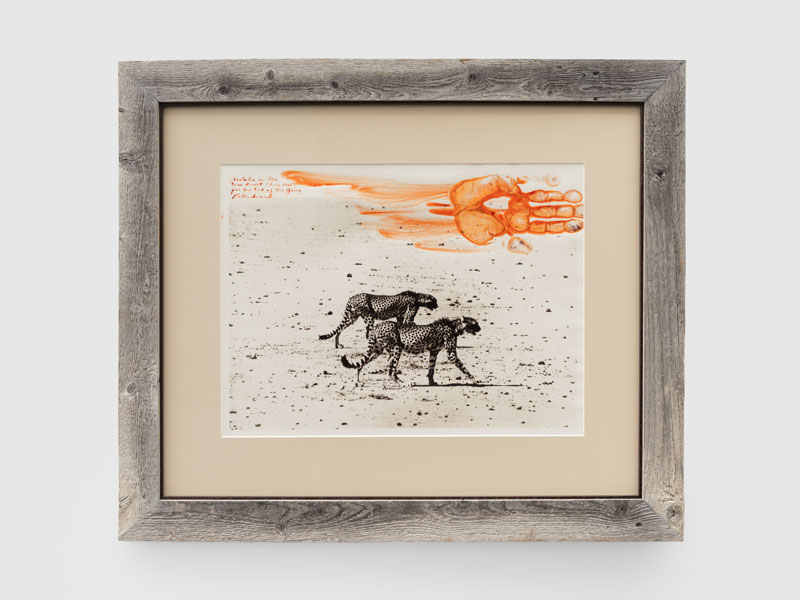
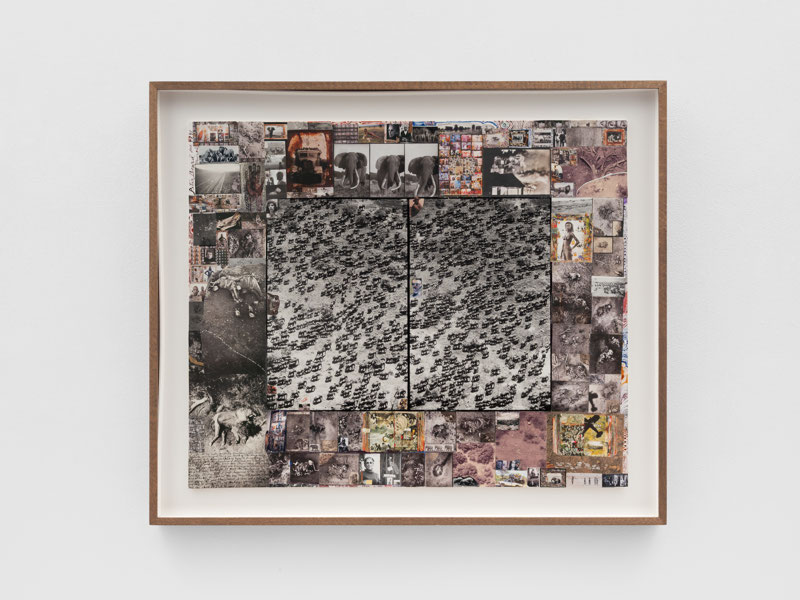
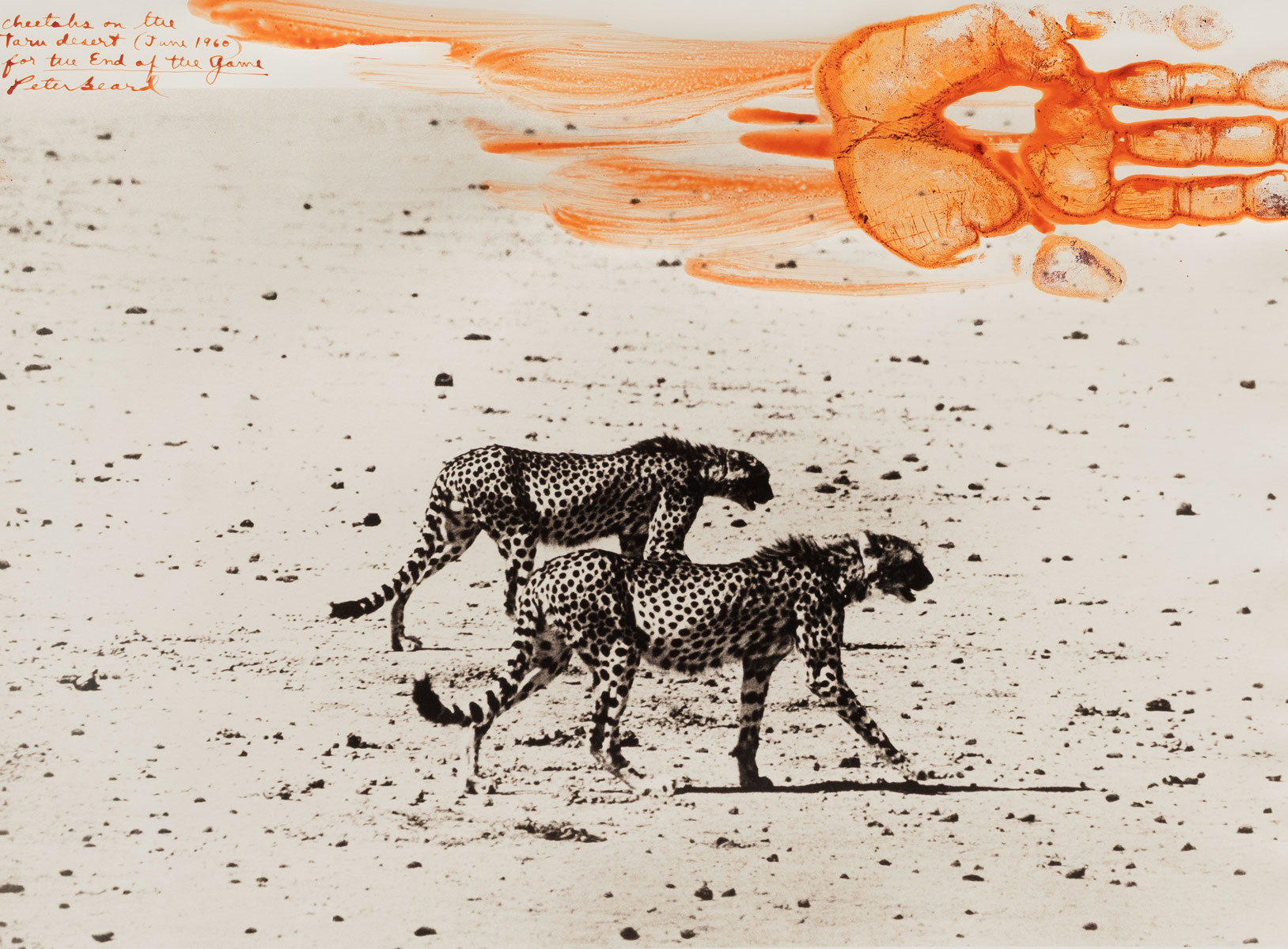
Beard’s ecological works, such as Elephants in Stressed Out Formation at Tsavo Park, Kenya (executed in 1976 and gifted to the artist Bob Dylan in 2013 with inscription verso) and Cheetahs on the Taru Desert for the End of the Game, June, 1960 (1960), further dissolve the boundaries between biological science and social theory and bookend the range of Beard’s compositional strategies presented in the exhibition. By rejecting the "hero shot" in favor of fragmented, panoramic collages, Beard translates the "density and stress" of vanishing habitats into a tangible visual experience. Whether through a kaleidoscopic border of news clippings surrounding a claustrophobic herd or a visceral, orange handprint marking the path of two cheetahs, Beard physically inserts his presence into the narrative. These material interventions—often made with ink or animal blood—act as a conceptual conceit that bridges the gap between the observer and the observed. Ultimately, these four works synthesize into a haunting record of life and decay, situating the artist as a permanent witness to a world in decline.
Born in New York City, Peter Beard (1938–2020) moved to Kenya in 1961, an event that would define the remainder of his life and career. He began splitting his time between Montauk, Long Island, and southern Kenya, where he established Hog Ranch, a tented camp that became a nexus for international artists, fashion icons, and conservationists. In 1965, he published his seminal work, The End of the Game, which documented the collapse of the Tsavo park ecosystem and helped establish him as a leading voice in ecological consciousness. During his lifetime, Beard’s work was exhibited in solo presentations at numerous influential institutions, including the International Center of Photography, New York (1977); The Seibu Museum of Art, Tokyo (1979); and the Centre National de la Photographie, Paris (1996). His first institutional retrospective in the United States, Peter Beard: Stress & Density, was held in 2016 at the Guild Hall Museum in East Hampton. Beard’s work can be found in prominent institutional collections worldwide, including The Museum of Modern Art, New York; the Victoria and Albert Museum, London; and the Metropolitan Museum of Art, New York.