From July 3 to October 11, 2026, Ceysson & Bénétière Panéry presents the exhibition Voir à travers, dedicated to the contemporary French sculptor Bernard Pagès.
Through the kitchen window, day after day, I watch Pagès’s latest sculpture rusting, yet also turning blue. I watch its skin of iron, its skin of copper metamorphose; through it I see time passing and the effects of the elements, sun or rain. I might even imagine that it is the wind that gives it its tilt, I was about to write its inclinations, and perhaps that is the word.
Pagès’s sculptures do not give themselves up easily, yet they have a leaning, a tilt, a soft spot for the living. They incline toward its delicacy, its oddness, its radical strangeness, seen up close, seen quite simply, and my gaze is guided by that of the artist, by his observations, by the attention he has always given to the world. The sculpture I am looking at: around a stake, two pieces of wood joined together, one covered in copper, the other in iron. The sculpture I am looking at is not so far removed from the phenomenological drawings of the 1970s, from traces of rain or sun, of passing time, from the registering of reality, methodical yet equally inventive, the registering of a reality that asserts itself and slips away in the same movement: the inclination of an entire life.
The sculpture that sets about rusting and turning blue bears the title Trophée. Yet nothing could be further from competition, victory, or reward than Pagès’s work. It is a faintly ridiculous title, almost comical (not ironic, for irony is not his strong suit). Or else, on the contrary, does it render burlesque that which seeks to impress us, an inadvertent snub to the black monolith of 2001: A Space Odyssey? Pagès’s work does not fall from the sky; it is not the doing of an all-powerful demiurge; it does not block our view, it does not try to impress us. It does not invite us to bow down, but to lean in toward the precious fragility of what is here below.
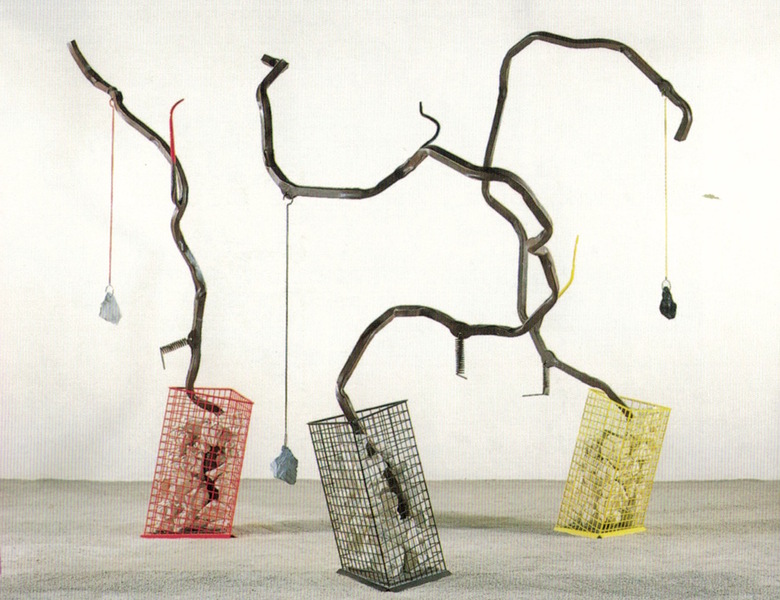
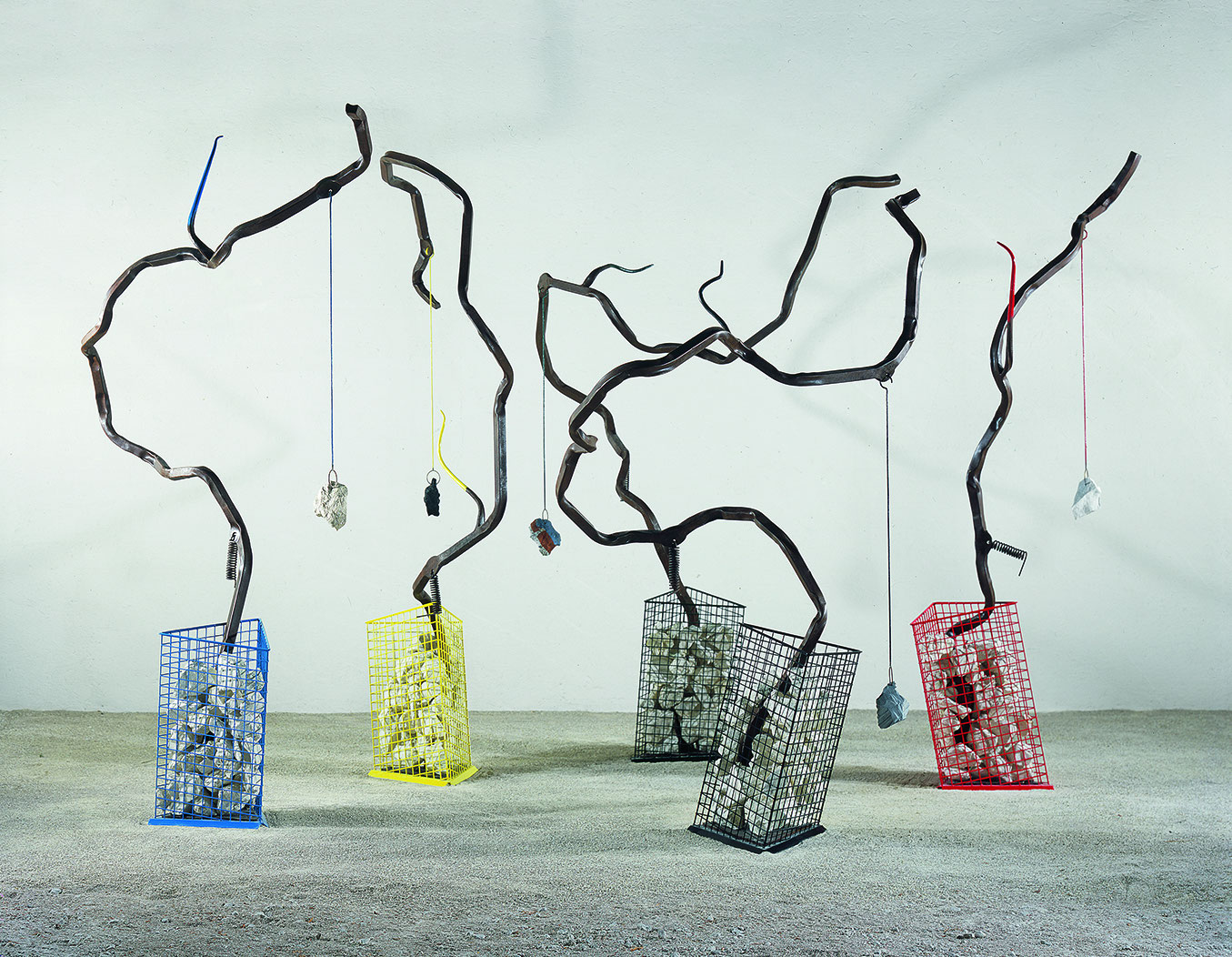
On the tendrils of vine stocks, for instance, evoked by metal springs in Ceps en foule (2000), a discreet insubordination to the order of cultivated vines. A crowd of vine stocks, gone wild, feral vines whose fruit would be the debris of the studio, fragments of colored concrete or charred wood. No wine will be drawn; Ceps en foule is for the beauty of the gesture alone, for nothing at all, and for the laughter this nothing stirs in me.
On the white stones inlaid with ceramic and heightened with a tender pink, sparkling stones that, through impregnation, become Les pierres roses (1984), brushing innocently against gleaming fragments of oil drums, the noble and the discarded no longer distinguishable from one another. The iron horns bristling from the pink stones take no offense; on the contrary, they seal an accord that abolishes hierarchies. All the more so as these iron horns were found in the sea, where they were softened and learned to insinuate themselves between things.
I am not going back in time; through it I see an unfailing constancy, and its infinite variations. They do not exhaust the world in the least, but unfold its possibilities. A ladder ready for the scrap heap is set into an olive stump and becomes L’Échelle de Jacob (2017–2018), yet freed of all angels; the copper is crumpled and takes on the lightness of paper, the metal beams, painted in bright colors, tapered and twisted at their tops, seem to beat their wings. One of them, in white, perhaps calls to mind the absent angels of the ladder.
So, in the end, why not a trophy? A trophy one might crown with a length of construction tape, Arrangement branchages et guirlande de chantier (1969), or with wild grasses whose very insignificance calls out to be noticed, Empreinte d’herbe et de boucharde de maçon (1971). Arrangements, assemblages, correspondences that the works on paper pick up on, yes, between grass and the manufactured, dried mud, wire mesh, the veins of wood, and the subtle color that brings them out. Minute, unheard conversations in which emerges what is threatened by disappearance, by chaos, by our futile accumulations.
So, in the end, why not a trophy, to salute this art of distinction.
Maryline Desbiolles