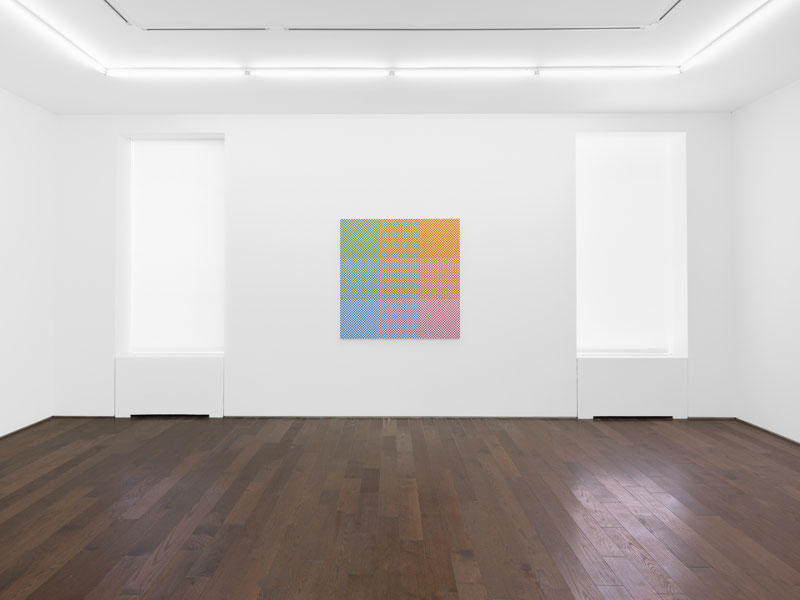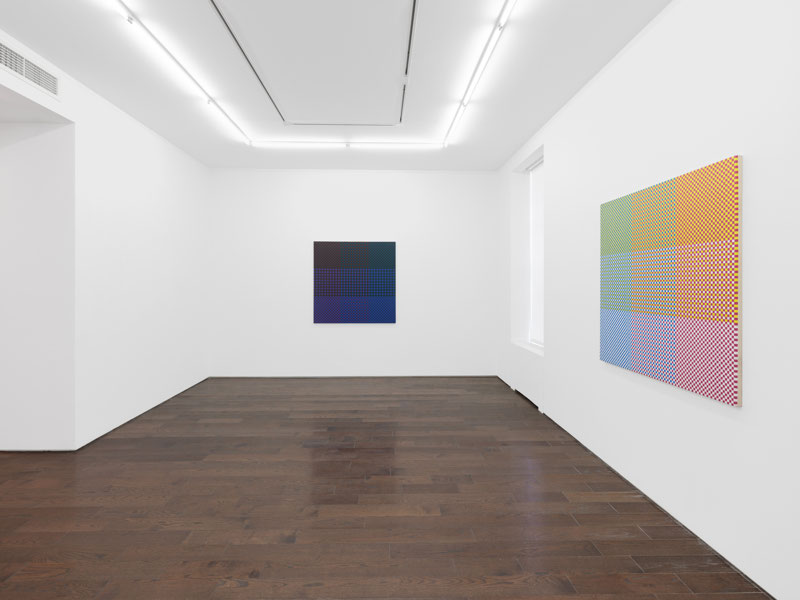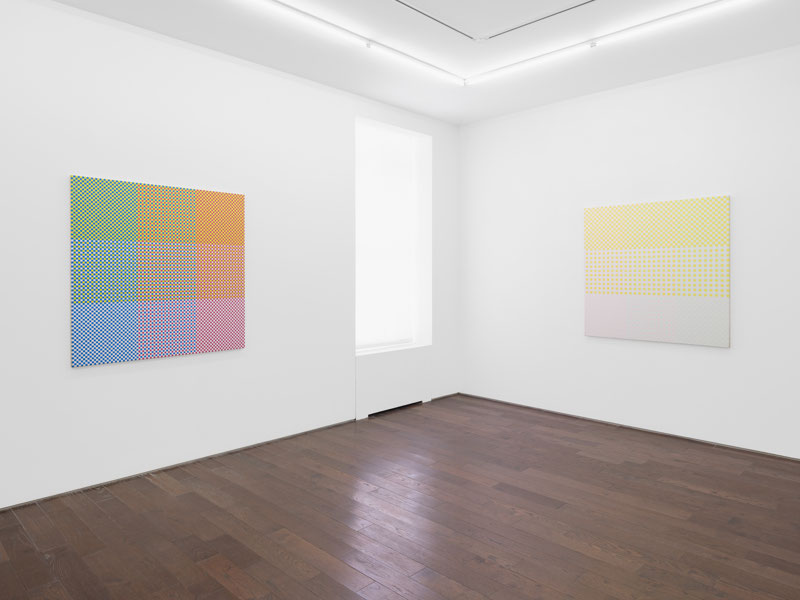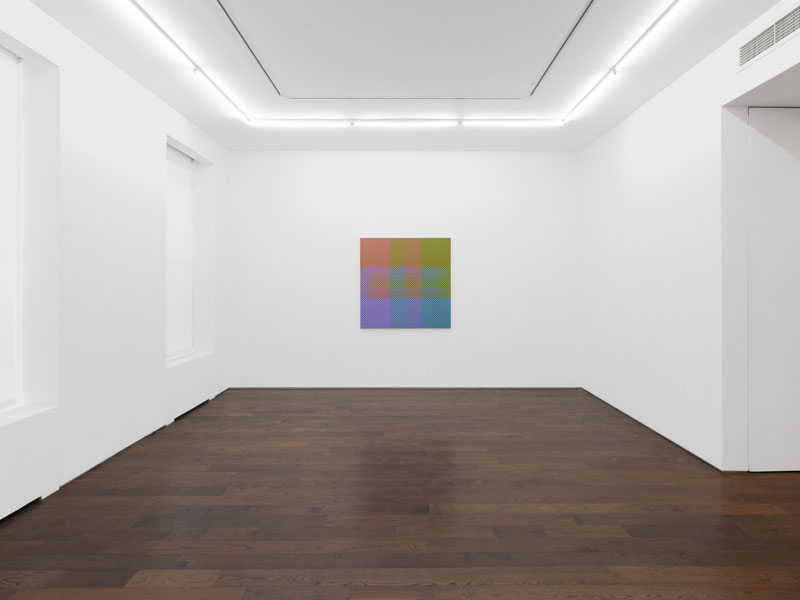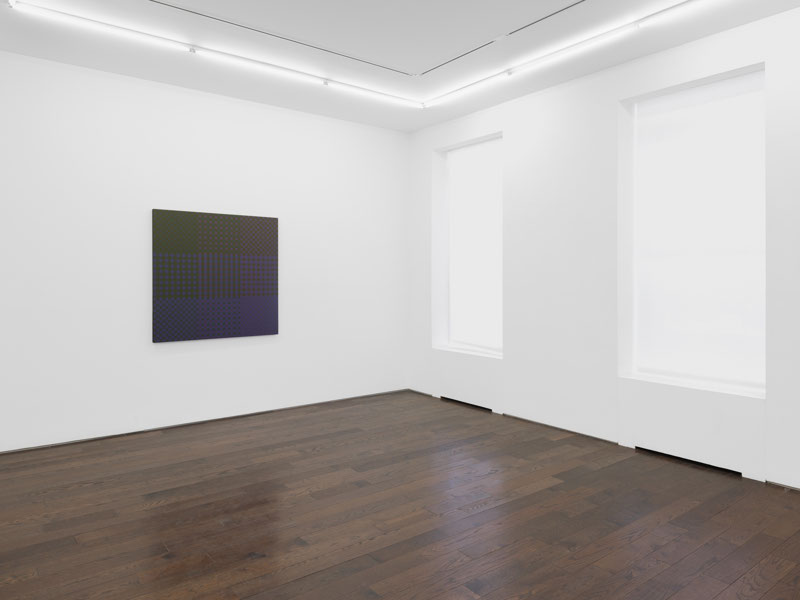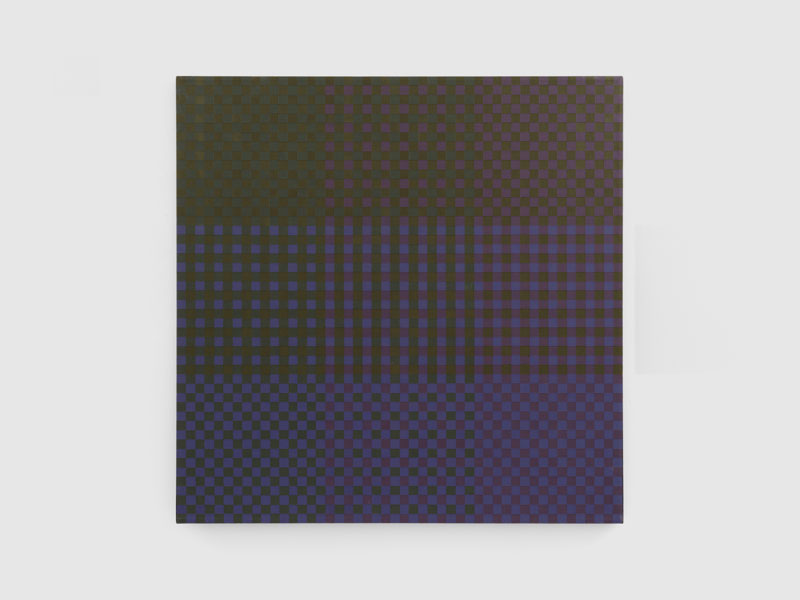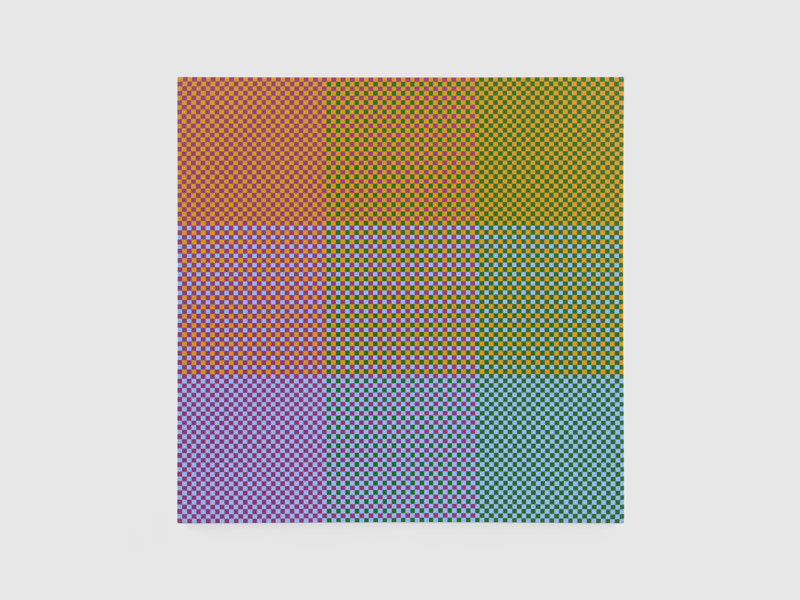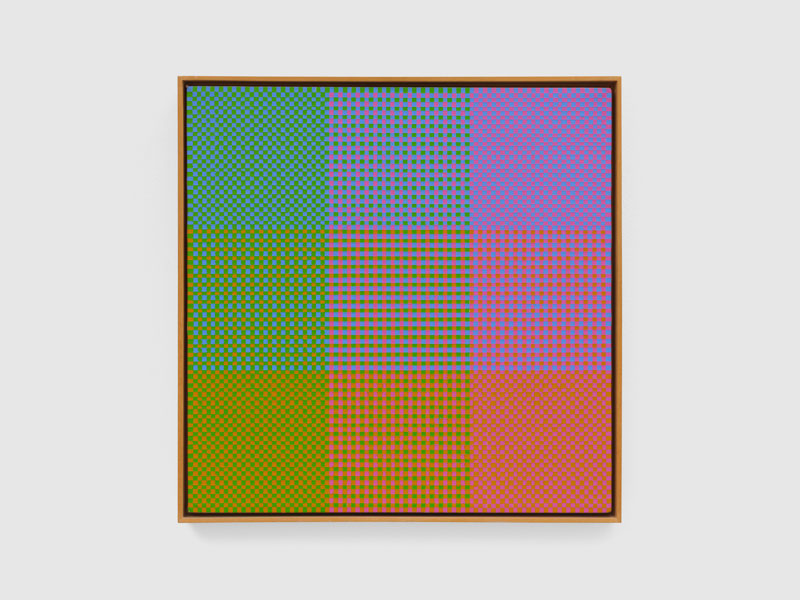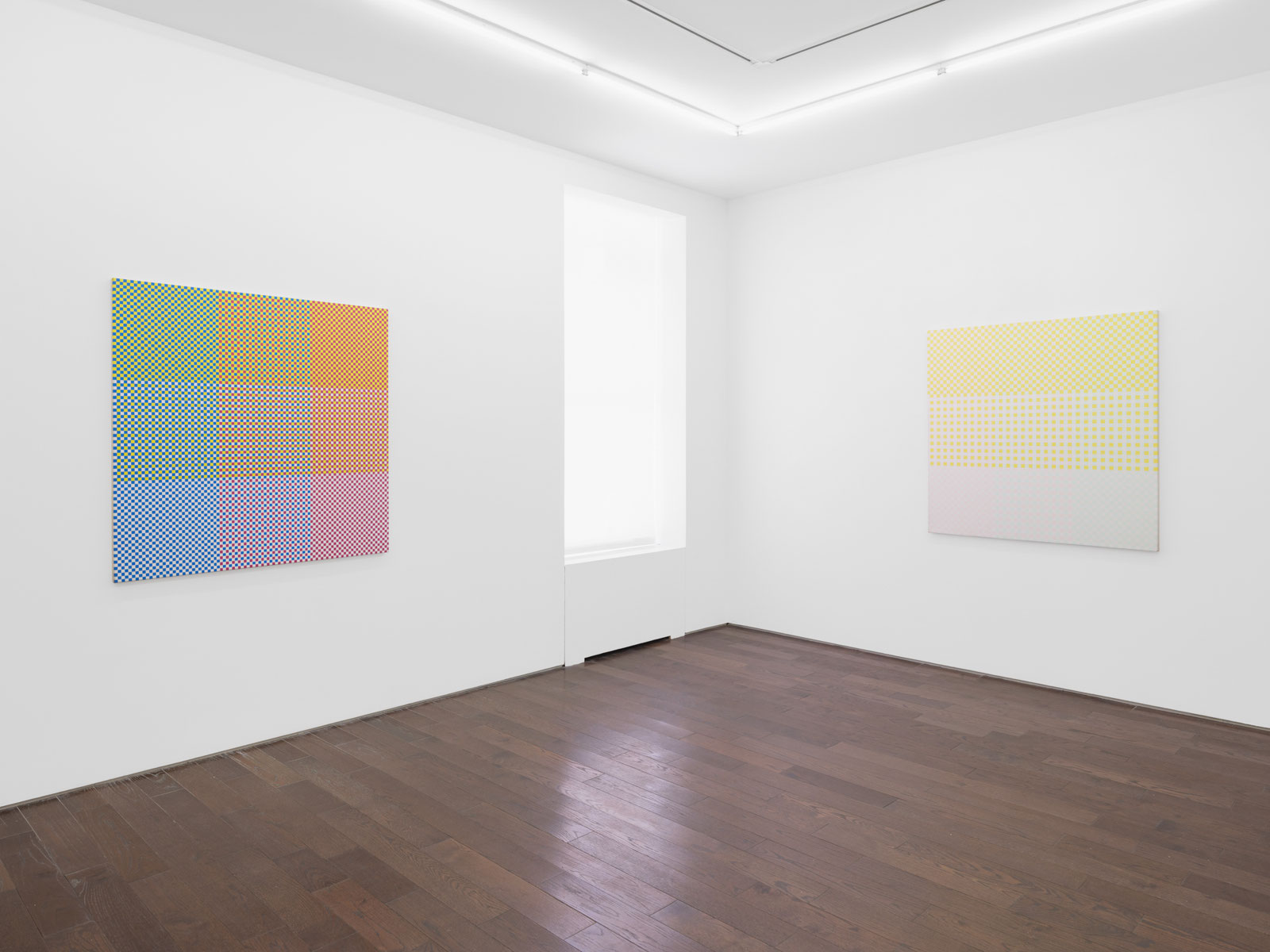
Ceysson & Bénétière is pleased to present Sanford Wurmfeld, Squares 1971-74. This exhibition offers a rare opportunity to view important, never-before-exhibited paintings by the New York artist. Throughout a career spanning seven decades, Wurmfeld has explored color as content, thoroughly committed to what philosopher Susanne Langer termed "presentational painting." In Wurmfeld’s work, color, like music, is a language unto itself, full of expressive potential.
The show consists of five 48-inch square canvases, which find the artist at the moment when he veered away from shaped canvases and made important developments that would sustain his work to the present day. The compositional strategy of nine large squares throughout the paintings recalls the work Ad Reinhardt, whose 1966 exhibition at the Jewish Museum had a profound impact on Wurmfeld. We can see a grid of nine in Wurmfeld’s own earlier shaped canvas, II-9 Orange, from 1968. This progression from shaped canvases to the square reflects the artist’s sustained investigation of painting’s parameters, which would pay off in spectactular ways in the coming years.
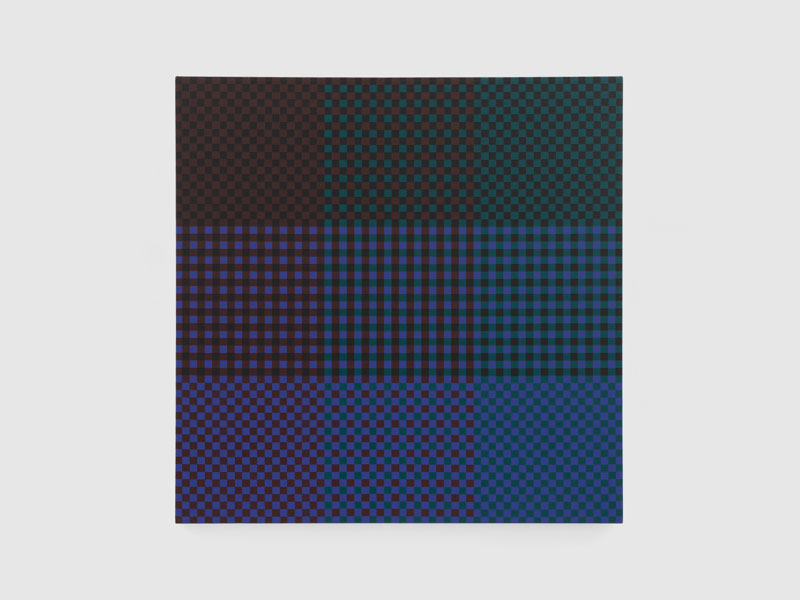
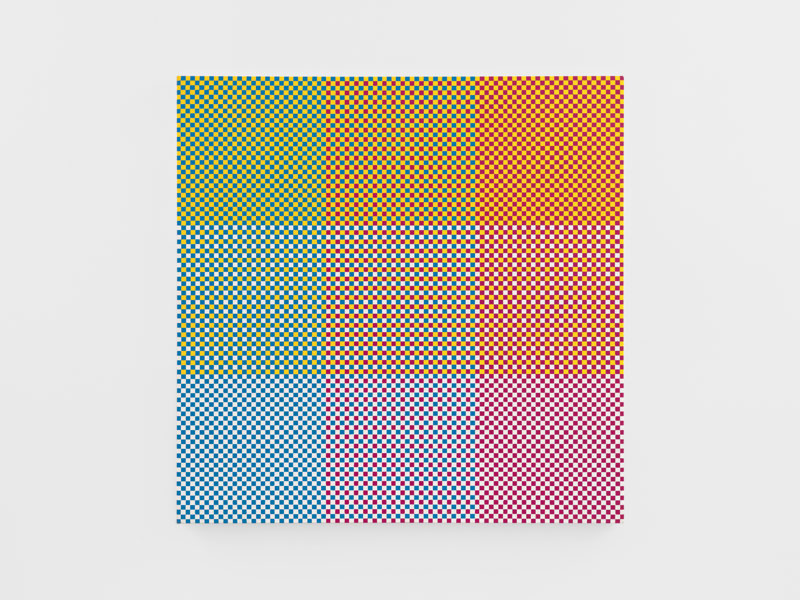
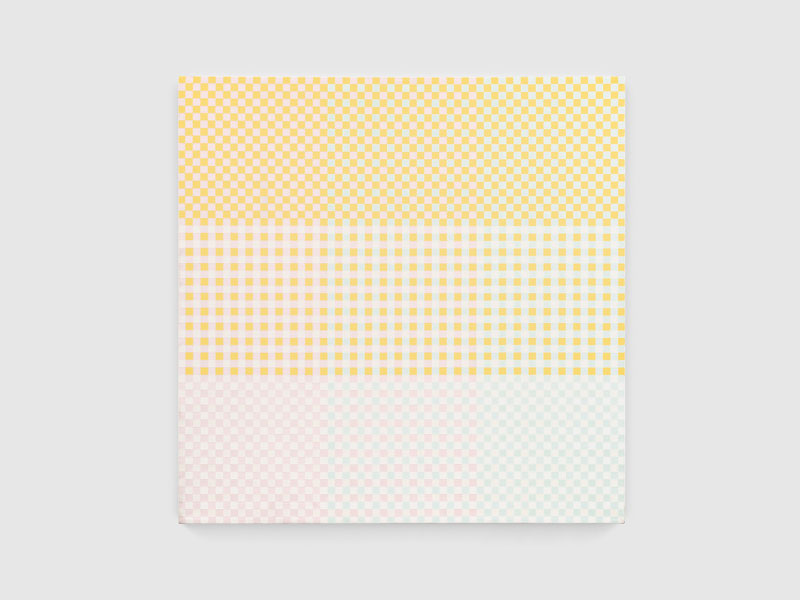
The paintings on view also contain the first examples of a technique that would come to define the artist’s work. Like Josef Albers before him, Wurmfeld limits his internal range of shapes to the basic unit of the square, which emphasizes the color relationships themselves, but Wurmfeld’s canvases are filled with hundreds of little squares, each acting as modules of light, activating one another. The size of the small squares varies from canvas to canvas, becoming larger when their contrast with each other is lower and smaller when the contrast is higher. With different combinations, they form nine larger squares per canvas, each of which appears to be a unique color.
A closer look reveals that each color is achieved by the judicious use of only two, three or four discrete hues, a technique known as optical mixture, in which colors are mixed in the eye and brain, not the palette, creating a dazzling sensation of uncanny colors — ones unobtainable through conventional mixing. Pioneered by Georges Seurat and Paul Signac, Wurmfeld takes this technique to new extremes, alternately unleashing a surge of crackling visual energy, as seen in Study for II-3H (Full Sat), or emerging more slowly with deep serenity, as in II-3H+Bk.
Barnett Newman famously insisted on the difference between size and scale — the relationship of parts to the whole, and, importantly, the relationship of the size of the viewer to the artwork. Human scale, Newman stressed. Study For II-4D is a standalone painting, part of a group of square canvases that developed into the the monumental 1972 painting, II-20 (Dk, Dn, N, Ln, L). The latter painting’s extremely wide format is early evidence of Wurmfeld's interest in horizontally scanning the visual field and filling the viewer’s peripheral vision. On family sailing trips, the artist was captivated by sustained viewings of the open sea, endlessly shifting in incremental color variation. The work points to Wurmfeld’s later Cyclorama series, the fourth of which is currently in production. The Cycloramas are massive panoramic paintings, entered via the floor, in which there is no beginning or end to the composition; a continuum of infinitely changing color effects enveloping the viewer.
Critic John Yau observed of Wurmfeld’s work, “we don’t change the object by seeing it. Rather, seeing is a temporal act.” The viewer’s experience deepens and changes with duration; it is revealed that not only do the small squares optically mix to form larger fields, they also interact on a granular level through simultaneous contrast, the principle that a given color can appear differently depending on its surroundings. It becomes hard to discern which colors are “factually” —empirically— different from one another and which are “actually” —apparently— different, to paraphrase Albers. Our conviction in the veracity of our own perception starts to destabilize. Maybe seeing isn’t believing. The overall result is beguiling—initially shocking and delightful, then begging to be “figured out,” before the investigation is subsumed by sensations, at which point the viewer lets go and enjoys the ride.
Jeremy Gilbert-Rolfe, in his Artforum review of work from this series, exhibited at Denise René Gallery in 1974, noted, “it seems quite un-paradoxical to say that Wurmfeld’s paintings seem to paint themselves. Overt paradox reemerges a second after one has said that, with the recognition that painting maintains itself on a reliance on phenomena that are at once impersonal and intuitively determined.” The tug between poles, between rational thought and the ineffable, is central to Wurmfeld’s work. A system of variables that are chosen by the artist lends the work idiosyncrasy. Once the system is activated —in other words, experienced by the viewer— the impersonal, scientific phenomena begin, yet these phenomena are perceived differently by each observer. The structure is not the point; rather, its effects are. The paintings are, in Yau’s words, “aesthetically refined, yet deeply human.”
A celebrated educator, Wurmfeld began teaching under the ethos that the act of teaching art would enhance not only the students’, but also the professor’s work as well. Any member of the generations of students who passed through Wurmfeld’s renowned Color Seminar would attest that the boundary between the artist’s scholarly and studio work was remarkably porous. Indeed, he and his colleagues at the Hunter College Art Department, where Wurmfeld was Chair for decades, came to be known as the Hunter Color School, such was their integration of theory and practice. In his classes, Wurmfeld demonstrated that color vision can be taught and developed, our eyes’ sensitivity furthered. There is always more to see, as these works testify.
Erik den Breejen, 2026
Sanford Wurmfeld (b. 1942 in Bronx, NY) has exhibited his work in solo and group exhibitions since the late 1960s. His work is included in collections worldwide, including the Solomon R. Guggenheim Museum, Metropolitan Museum of Art, Brooklyn Museum, Philadelphia Museum of Art, Karl Ernst Osthaus-Museum, Sprengel Museum, and Espace de l’Art Concret, and the City of Hannover Germany.
In 2013, he was the subject of a major 45-year survey exhibition entitled Sanford Wurmfeld: Color Visions, 1966-2013 curated by William C. Agee at Hunter College/Times Square Gallery, NYC. He has also presented solo exhibitions at Neuberger Museum of Art, Tibor de Nagy Gallery, Galerie Denise Rene, Susan Caldwell Gallery, David Richards Gallery, Minus Space, Bard College, Maxwell Davidson Gallery, Karl Ernst Osthaus-Museum (Germany), Mucsarnok Kunsthalle (Hungary), Talbot-Rice Gallery (Scotland), and Ewing Museum Gallery (Knoxville, TN).
After graduating from Dartmouth College in 1964 with a BA in Art History, Wurmfeld moved to Rome and spent two years painting before returning to New York where he has lived and worked ever since. In 1968, he was the youngest artist included in the landmark exhibition Art of the Real 1948-68 curated by Eugene Goossen at the Museum of Modern Art, NY. The exhibition traveled for the next two years to the Grand Palais (France), Kunsthaus (Switzerland), and The Tate Gallery (London, England). Wurmfeld’s other museum group exhibitions include the Carnegie International, American Academy of Arts and Letters, National Academy Museum, Visual Arts Center of New Jersey, Dayton Art Museum, Akron Art Museum, Allentown Art Museum, Long Beach Museum of Art, New Bedford Art Museum, Karl Ernst Osthaus-Museum (Germany), and Espace de l’Art Concret (France), and Museo de Arte Contemporaneo de Buenos Aires (Argentina).
Complementing his studio practice, Wurmfeld has lectured and written extensively on the history of color, painting, and abstraction. He has received awards from the John Simon Guggenheim Memorial Foundation, National Endowment for the Arts, City University of New York, and Dartmouth College.
In addition to his artistic work, Wurmfeld taught in the Department of Art at Hunter College from 1967-2012, where he educated and mentored countless generations of artists. Originally invited to join the faculty by artists Tony Smith, Ray Parker and critic Eugene Goossen, Wurmfeld was Chairman of the department from 1978-2006 and founded the renowned Hunter MFA program in 1981.