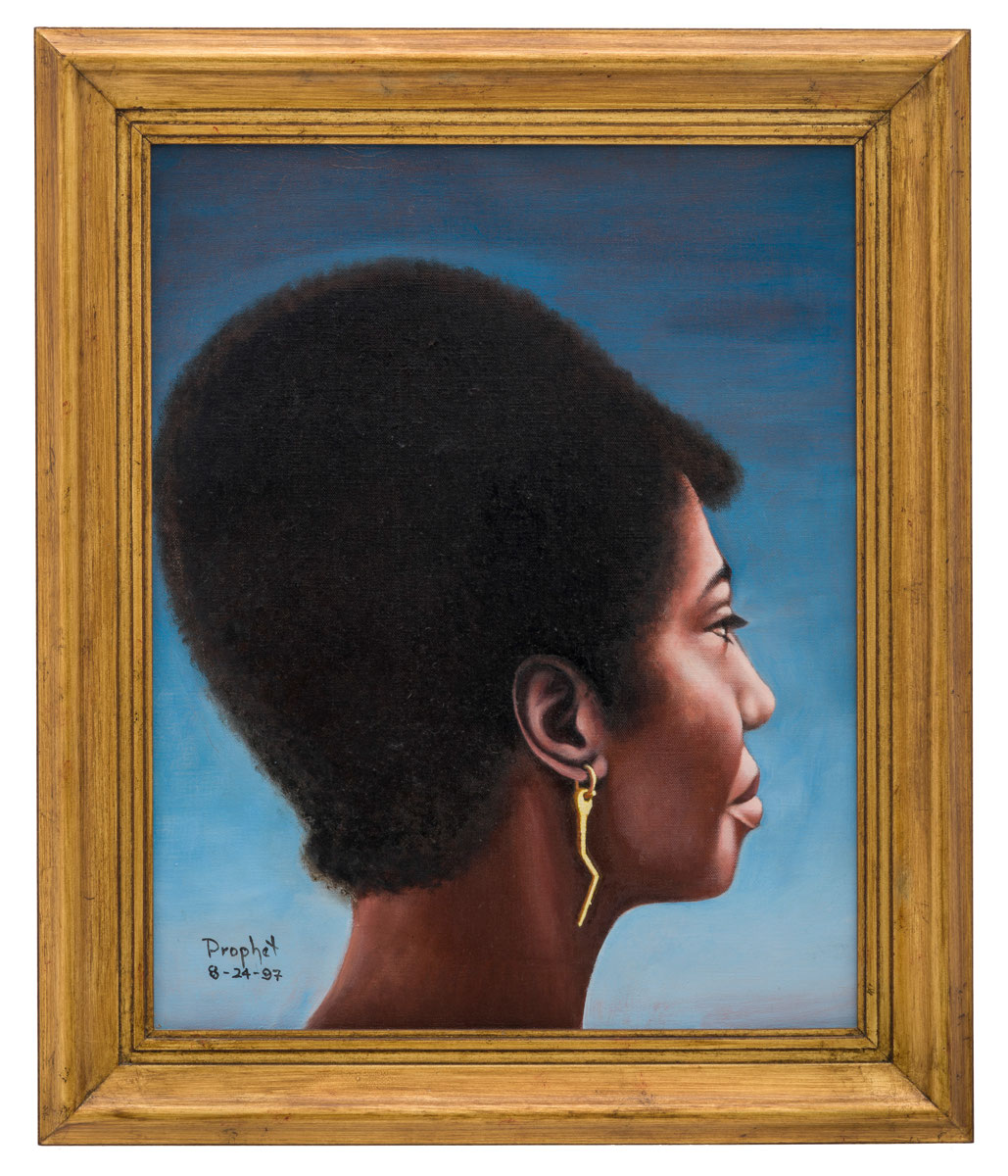
Ceysson & Bénétière New York proudly presents The Paintings of Richard “Prophet” Jennings: 1958–1997, the first survey devoted to the paintings of Richard Slater Jennings (1922–2005), curated by Parker Jones. Bringing together works spanning four decades, the exhibition offers an unprecedented view of an artist whose work emerged at the intersection of painting, jazz, journalism, performance, and the cultural life of postwar Black America. The exhibition will be on view from September 10 through October 24, 2026, with an opening reception on Thursday, September 10, from 6:00 to 8:00 p.m.
Although Jennings is perhaps best known for his paintings reproduced on landmark jazz recordings from the early 1960's—including Thelonious Monk’s Thelonious Monk with John Coltrane, Eric Dolphy’s Outward Bound and Out There, and Max Roach’s It’s Time—his artistic practice extended far beyond the record cover. Working without formal artistic training, Jennings developed a highly personal visual language that moved fluidly between portraiture, figuration, symbolic imagery, and landscape. His subjects include musicians, children, elders, streetscapes, flowers, and nudes. The works in the exhibition trace the evolution of this practice from Jennings’s early years in Detroit through his immersion in the New York jazz avant-garde, his years in Sweden, and his later life in Los Angeles. Together, they reveal an artist whose approach to painting was fundamentally improvisational—responsive to people, places, and experiences rather than governed by a fixed style.
I never had any style. I just did it.
Born in Youngstown, Ohio, in 1922, Jennings came to art through an unconventional convergence of performance, journalism, illness, and lived experience. By the age of sixteen, he was an accomplished dancer, performing with the swing band Billy Hicks & His Sizzling Six and developing relationships with musicians and entertainers that would shape the course of his life. Shortly before his eighteenth birthday, he contracted tuberculosis and spent the next three and a half years in a sanatorium. During his confinement, Jennings began writing, contributing a column to the Buckeye Review. Writing became both a vocation and a form of expression after his release, leading to positions at several African American newspapers, the creation of his own publications, and the development of a distinctive rhythmic prose style rooted in music, entertainment, and the language of the street.
It was also during his hospitalization that Jennings first began to draw. Doctors provided him with pastels, chalks, and charcoal as a means of passing the time, introducing him to a practice that would eventually become central to his life. Following his discharge, however, he did not immediately regard himself as an artist. His art education was largely self-directed, shaped by books on art history and technique, close observation, and his engagement with artists in Youngstown and, later, Detroit.
After his release from a second period of hospitalization in 1950, during which he underwent treatment for heroin addiction, Jennings settled more deeply into Detroit’s cultural and social milieu. He described this period of his life as one of “healing and dealing,” moving between legitimate work and the city’s underworld, where he encountered musicians, artists, hustlers, healers, and fortune tellers. These experiences became an important source of both subject matter and creative energy. Rather than separating his artistic life from the world around him, Jennings absorbed its contradictions—its beauty, violence, humor, spirituality, and struggle—into his work.
Detroit also provided Jennings with important artistic models. In a 1999 interview, he recalled the influence of painters Hughie Lee-Smith and Leroy Foster, as well as the painter and sculptor Artis Lane. Lane had exhibited her work in the lobby of Detroit’s Gotham Hotel, a venue that would later host Jennings’s own exhibitions. His first public presentations of pastels in the mid-1950s were followed by his first solo exhibitions, where he began to attract attention for paintings that combined portraiture and scenes of everyday life with more psychologically charged and allegorical imagery. Playground After Midnight, a pastel on paper from 1955, was subsequently included in his debut solo exhibition of the same year, Expressions in Pastel, and is among the earliest works represented in the present survey.
By 1958, Jennings had begun to establish himself not only as a painter but as a distinctive cultural figure. It was around this period that the name “Prophet” came to define him, reflecting the role he increasingly occupied among musicians and artists: part adviser, part philosopher, part confidant, and always an attentive observer of the world around him. That same year, Jennings left Detroit for New York, entering a musical community in the midst of profound transformation. Bebop was giving way to hard bop, modal jazz, and the emerging avant-garde, and Jennings quickly formed close relationships with musicians including Sonny Rollins, Eric Dolphy, and Freddie Hubbard. His home and studio became gathering places for artists at the forefront of this evolving scene.
Jennings’s paintings soon became deeply intertwined with the visual and social culture of jazz. His work appeared on several influential recordings of the period, while his relationships with musicians extended beyond album covers: Eric Dolphy, Freddie Hubbard, Max Roach, Milt Jackson, and Nat Adderley all dedicated compositions to him. In 1962, Jennings and Sonny Rollins developed a series of “Art & Jazz” presentations in which Rollins performed in front of Jennings’s paintings, creating an environment in which visual art and musical improvisation became mutually responsive. The collaboration offered a particularly direct expression of Jennings’s understanding of art—not as a fixed or prescribed form, but as something responsive, intuitive, and continually in motion.
My life has been one big improvisation. That’s what it’s all about.
In 1964, Jennings moved to Sölna, Sweden, with his future wife, Ann-Charlotte Dahlqvist, a Swedish flight attendant for SAS whom he had met in New York two years earlier. The couple married and welcomed a daughter, Dominique, in 1965. Jennings exhibited his work in Stockholm in 1966, where his paintings were shown to an audience that included prominent Swedish intellectuals and cultural figures. Following the tragic death of Ann-Charlotte in the 1969 crash of SAS Flight 933, Jennings and his daughter returned to the United States in 1972, settling in Los Angeles. He continued to paint while raising his daughter and maintaining close relationships with musicians, artists, writers, and entertainers.
During his years in Los Angeles, Jennings’s work was presented in a series of intimate exhibitions, including a 1971 presentation at the Bel-Air home of jazz musician Cannonball Adderley and a 1974 exhibition at the Beverly Hills home of Clarence and Jacqueline Avant. In 1975, Richard Pryor presented Jennings’s work in a solo exhibition at Comara Gallery in Los Angeles, Jennings’s last known solo exhibition. Jennings continued to paint privately for the remainder of his life, living in West Hollywood until his death in 2005.
Long recognized within the history of jazz for the images he created for some of the music’s most consequential recordings, Jennings emerges here as an artist whose work deserves consideration on its own terms. His paintings constitute an idiosyncratic record of a life lived in close proximity to cultural transformation—a body of work shaped by illness and recovery, music and language, friendship and loss, and, above all, by an enduring commitment to improvisation.
Parker Jones, 2026