Presentation

Clédia Fourniau says she “makes” her paintings. This is her way of emphasizing their quality as objects and how she makes them, somewhere between industrial production and experimental cooking. Using tools and products seemingly unrelated to the realm of painting (like a resin used in the nautical industry and pastry cases), the artist creates her paintings through a process that combines mechanistic precision and research, meditation and spontaneity.


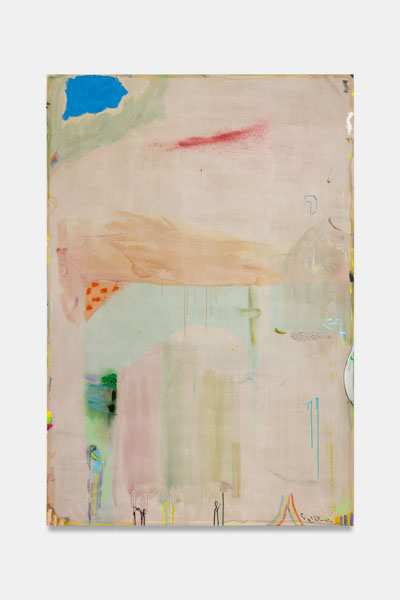
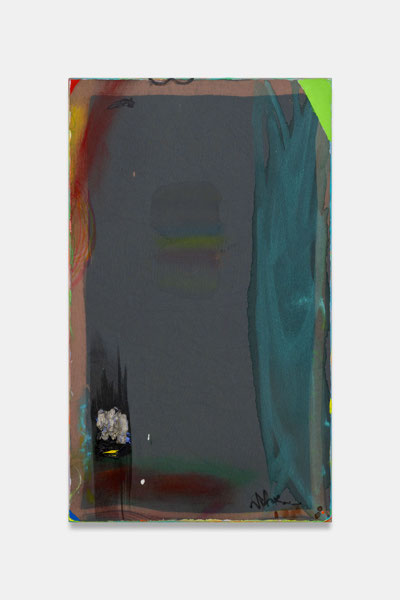
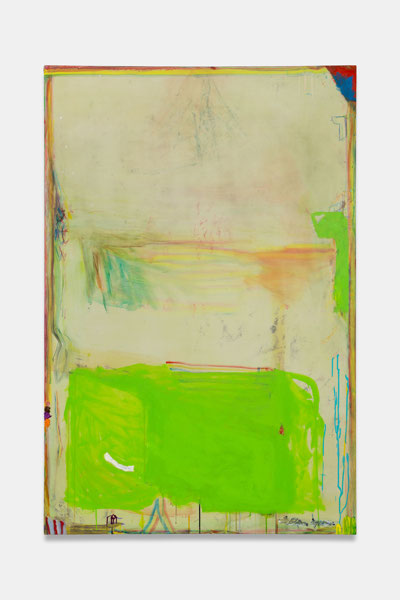
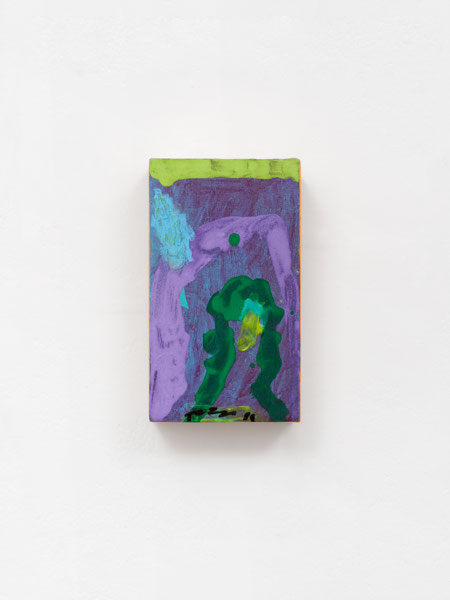
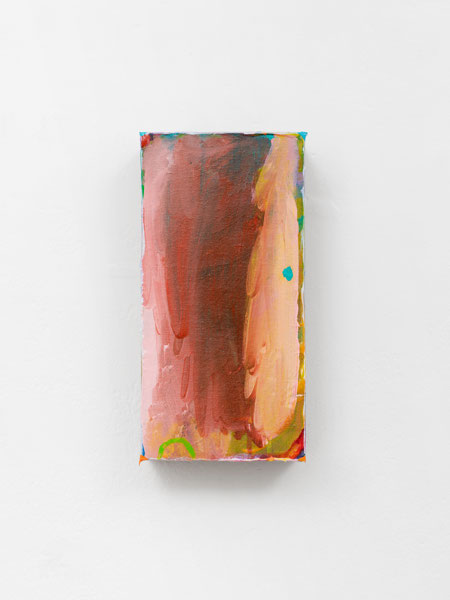
Fourniau’s paintings owe their metallic appearance to the same alkyd resin used to lacquer boat hulls. She applies a series of layers and brushstrokes of vibrant colors, which spread across the canvas: acid yellow, rich violet, mint and apple green, blood orange. On occasion, she uses a mica powder-based bonding agent to enhance the surface with a pearlescent finish. This ultra-toxic, sugary concoction makes her paintings candy for the eye; their visual immediacy absorbs the viewer’s eye, simultaneously causing it to slide towards the edges or back to its own reflection. After training at Paris’s École nationale supérieure des beaux-arts, Fourniau long avoided the act of painting, instead testing other creative techniques like silkscreen printing, whereby two-dimensional images are produced in series. Only in the final years of her education, while working in artist Tatiana Trouvé’s studio, did she begin painting on canvases flattened on sawhorses. This technique, which dictates the body’s relationship to the canvas, helped her develop a distinctive method that involves casing the sides of the canvas before pouring resin into the center. Indeed, her paintings during the 2021 and 2022 period, which she unveiled for her final study project and later at the Pernod Ricard Foundation (among others) are characterized by restrained, sporadic gestures. The canvas is literally boxed in, and the frame motif is echoed within the painting itself, further limiting the spread of the paint in the canvas’ center, as if squeezing its content, at the very least, delaying its appearance. It is these “band by band” gestures that ultimately “make” the image.


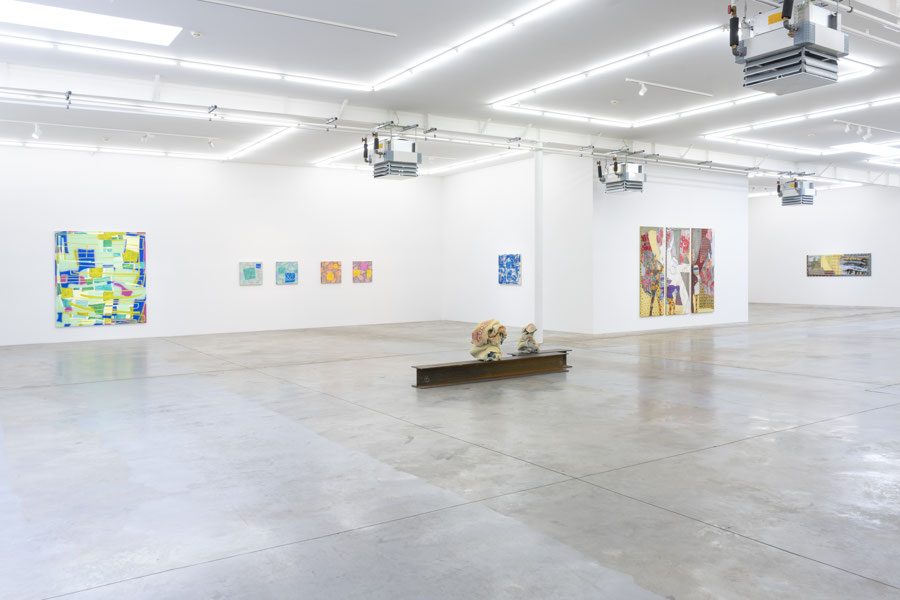
In her 2023 exhibition at the König gallery in Berlin, most of the paintings bore the title Colombes, after the town in the Paris region where they were made. This choice emphasizes the moment of production and decisions that took place therein. In her workshop, the artist begins by choosing the canvas format, and then the textile she will use to cover the frame, opting for colored or printed fabrics versus the immaculate cotton canvas of her early works. The patterns and colors give the work its initial momentum and guide the creative process. Once assembled, the textile is encased by a formwork – a gesture the artist continues to use, although it is no longer technically necessary to her work. She then baptizes the canvas with brushstrokes of acrylic paint, the first of a series of layers, which she spreads side by side or on top of one other.


While the resin encapsulates the decisions, actions and revisions done over time periods ranging from a few weeks to several years, the final work systematically defies our comprehension of the creative process behind them: in truth, it is difficult to read the chronology of their surfaces. As time goes one, Fourniau’s canvases have become more complex, with old techniques (like formwork) amalgamating with newer methods. The paintings are archives of the experimentation process and the gradual appropriation of the medium and its possibilities. Sometimes the surface is not entirely covered, and areas of unpainted textile appear amidst the saturated colors and gleaming varnishes, like quiet spaces in the din of color, a void in the midst of excess.The lightening of the palette and gestuality that characterizes Fourniau’s 2023 works demonstrate greater permissiveness towards painting. Working on the ground instead of on sawhorses brings the body closer to the canvas, frees movement and facilitates use of the brush, while the dimension of pleasure seems to have opened up her chromatic range. Codified by disciples of abstract expressionism, led by the American painter Jackson Pollock, physical movement in the painting has long been the prerogative of the able-bodied, white male, who performs gestures for the camera as much as for the result conveyed on the canvas. Spontaneity in painting is not innate; it is cultivated over time spent in the studio.


In this sense, Clédia Fourniau plays with the “trickiness” intrinsic to abstract painting. Her works draw us in by the brilliance of their surfaces and colors, and yet deceive us by the seeming simplicity with which we interpret them, the apparent spontaneity with which they were made, as well as their inability to be accurately captured by digital media. Because nothing is worse than viewing Fourniau’s paintings on a screen: we are unable to appreciate the interplay of matt finishes and brilliance, the superposition and proximity of the hues, the places where the fabric shows through, or their relief. Their thick edges encourage viewers to take a step aside. Hence we must free ourselves from the confines of the surface, for this is where the painting begins.


Elsa Vettier

Selected Artworks
Ok ok, ok ok ok
Ok ok, ok ok ok
2025
220.0 x 150.0 x 8.0 cm / 86.6 x 59.1 x 3.1 in
La possibilité, l'occasion
2025
54.0 x 65.0 x 5.5 cm / 21.3 x 25.6 x 2.2 in
L'heure du goûter
L'heure du goûter
2025
50.0 x 35.0 x 7.0 cm / 19.7 x 13.8 x 2.8 in
Exhibitions In Our Galleries
All Exhibitions

Selected solo and group exhibitions include:

KÖNIG GALERIE, Seoul, South Korea (2024);

Reiffers Art Initiatives, Paris, France (2024);

Collection Lambert, Avignon, France (2024);

KÖNIG GALERIE, Berlin, Germany (2023);

Poush, Aubervilliers, France (2023);

BLANKgallery, Shanghai, China (2023);

Fondation Pernod Ricard, Paris, France (2022);

Galerie Vallois, Paris, France (2022);

Sisley, Paris, France (2022);

Fonds de Dotation Weiss, Paris, France (2022);

Galerie Paris-B, Paris, France (2022);

Double Séjour, Clichy, France (2021).


Her work has been acquired by the Société Générale Art Collection and the FRAC Auvergne institutional collection (France).

Bibliography

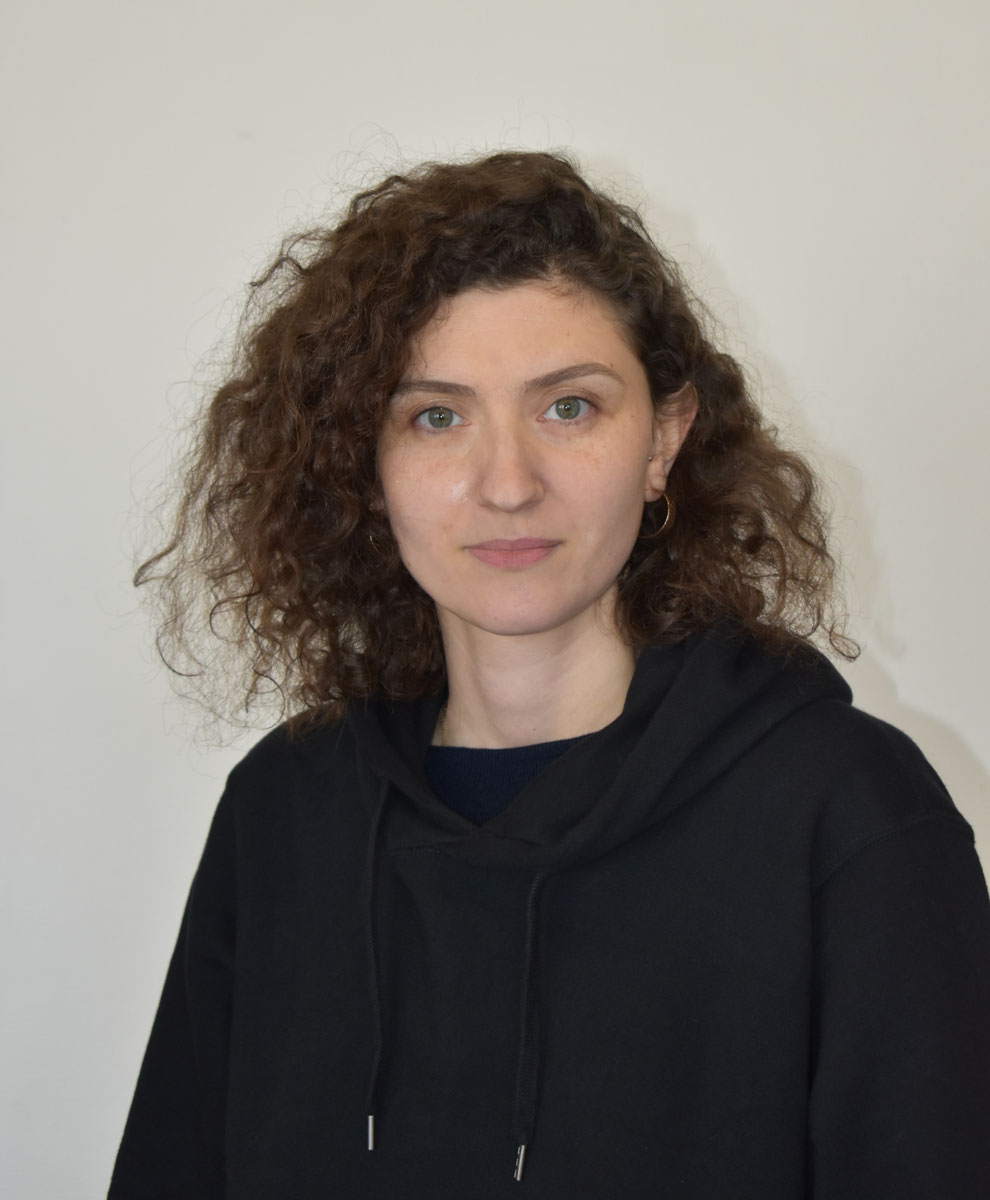
Clédia Fourniau (born in 1992 in Paris) lives and works in Paris. She earned a BTS in Spatial Design from ENSAAMA Olivier de Serres and graduated from the Beaux-Arts de Paris.

Her work explores the possibilities of painting and representation, questioning the conditions of creation, perception, and reception of an image. In a continuous dialogue with formal experimentation and chance, she combines various materials and supports, such as dry pigment, oil paint, mica, acrylic, resin, and, more recently, watercolor and colored pencil, applied on linen canvases or dyed and often primed textiles. The glossy resin, selectively applied, creates a self-reflexive dialogue between image and reality by incorporating the surrounding space and the viewers into the painting’s field.

Her work, deceptively impulsive, also plays with the exhibition format and interrogates ideas of seriality and repetition. For Clédia Fourniau, the painterly gesture—deliberately citation-based—is fundamentally dependent on process and material, rooted in a practice of waiting that unfolds day by day in the studio, within a stretched and unpredictable temporality.

She has received several awards, including the Sisley Beaux-Arts de Paris Prize in 2022 and the Reiffers Art Initiatives Prize in 2024. She was also awarded the Friends of the Beaux-Arts de Paris grant in 2022.