Lives and works near Brussels, Belgium
Gathering Evidence
Jack Hanley, New York 2015
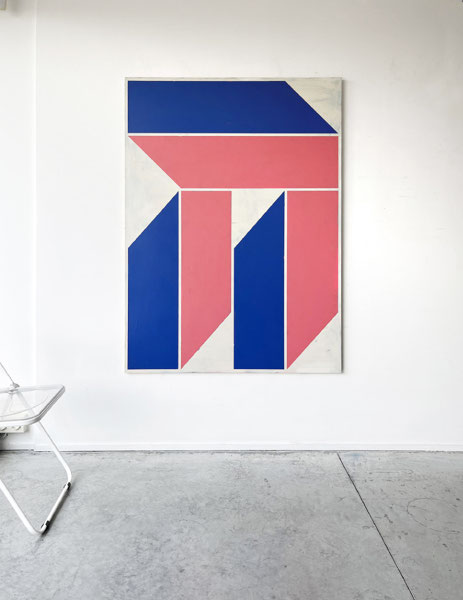
There is an interesting symbiosis in the small paintings of Alain Biltereyst, between a concrete poetic formality and allusions to earlier abstract illustrations of utopian thinking. The works are at once references to popular assimilations of these historical tropes and also to their commercial applications.
The permeation of abstract (once Modernist) imagery in our visual world is so commonplace that we rarely consider the manhole cover or the fence design or the painted tail of an airplane, except in the most offhand manner. Alain Biltereyst continually draws attention to the practical uses and references to these earlier forms. He salvages the gems of color and shape and placement in our advertising and design visuals and carefully isolates the forms and tweaks the colors to have these diminutive works operate in the space between a precious object and fragment of the design canon.
The carefully chosen scale and brushy overpainted surfaces draw the viewer in to appreciate the beautifully crafted works. Often shown in a series, these paintings act as a sort of alphabet, discreet units that build on each other. They are not exactly formulating a word, but still do coalesce into changing statements depending on their various arrangements.What were once forms developed years ago, abstractions from ordinary life with its colors and shapes, Alain brings back full circle from their pop cultural use. His interest in the Modern and the way it has permeated our popular culture is balanced with his careful approach to his painting. Working on thick almost tile-like small panels, there is an attention to layering, surface and particular colors and shapes.
The precise object-like use of thick, uniformly-sized painting panels draws attention to these works as units. His installation of these panels is often enhanced by being exhibited on a precisely painted color wall. His practice also incorporates stand alone wall-painting with the same colors and motifs. Alain’s idiosyncratic, almost reverent approach, treats this source material as a precious find. He manages to refer to earlier historical abstraction while simultaneously cataloguing his world and its practical use of these historical precedents.